Saturday, January 31, 2015

Max's Story


Parenthood is over.  It's one of those classic network TV dramas they probably won't make ever again, not a lot of cool factor, not a lot of anti-heroes and super-sleek dialog and broody, alpha-dog pretensions (True DetectiveBreaking Bad, House of Cards, etc.).  Parenthood just did what it needed to do, detailing the lives of a sweet, sometimes loud, messy, middle-class family in Northern California as they live their lives (and sometimes got into a few trumped-up, only-on-a-network-TV-hour-long-drama situations).  I've always been a big fan of shows like this, from thirtysomething on, because they have a soothing comfort emanating from their very cores, an optimism that doesn't seem fake as much as utilitarian in a heightened way:  people getting by, only in better clothes and better light.  Like the family hour-long dramas before it, Parenthood transforms domesticity by trying very hard to be real, elevating banality into a beautiful consumerist Utopia:  backyard candle-lit family-style dinners, low-key folksy alternative music defining scenes, set-decorated kitchens and living rooms and bedrooms and other spaces radiating that lived-in loveliness, but also somehow perfect, like museum exhibits with people added in.  You just want to jump into those scenes and be a long-lost relative with your own narrative arc, your own Iron and Wine song on the soundtrack.
 
The one narrative arc I want to write about the most is Max Braverman's, played by Max Burkholder.  Diagnosed at the beginning of the show with autism, Max's story has always been defined/coded/enlivened/oversimplified by that labeling, and yet without the label Max would not be Max.  Which is always the problem with representing people with disabilities in pop culture:  you don't want the diagnosis to be the only narrative force, and yet you can't ignore the force of a diagnosis on someone's story.  Parenthood worked all of this tension through allowing Max to be both a "hindrance" and a "blessing" and then getting rid of that binary and getting down to business by allowing Max to grow up just like anybody else.  The one phony and kind of dopey road the show took was allowing Max's mom and dad, Adam and Kristina Braverman, penultimate helicopter parents, to open up a special charter school for "people like Max," so he could be "protected" from bullies and other obstacles.  The school opened the beginning of the second-to-last season, and it really didn't come to any kind of dramatic fruition in this season:  it became a blank space, occupied by a nameless cast of "people with autism" peopling the background while Kristina and Adam figured out how to run it.  Max was a student there, and he got into just as much crap as he probably would have in any other school, but the show's folksy, romanticizing, politically-correct gaze made the school seem idyllic without showing us what "idyllic" means. 
 
But still, there was Max, at the end of the show, all grown up, with a camera.
 
The camera is the key.
 
Max was introduced to the camera by Ray Ramano's Hank Rizzoli, his Aunt Sarah's boyfriend who also turned out to be her one true love.  Hank, a professional photographer, through meeting up with Max, soon discovered that he himself was "on the spectrum," and Max and Hank's relationship blossomed from awkward side-glances to a true friendship/mentorship.  Hank taught Max the professional-photography ropes, Max got an internship, a summer job, and then finally, by the end of the show, a career path. 
 
When characters with developmental disabilities on TV shows like Parenthood appear, they are often tokens or background music, ways to define other people's kindnesses or meannesses.  In Parenthood, though, Max is given agency and desire, and he is also allowed to discover he can do things, he can have a professional life even though he's been labeled, consigned to a "special school," and often the object of ire and derision, when not being overly comforted by his sweet parents who just want him to be happy. 
 
Max's narrative arc, from lost boy to wedding photographer, is heartening because it pushes away notions of consignment, and allows us to understand the way "community" actually is supposed to work.
 
"Community" is one of those buzz-words right now in the business I'm in, trying to help people with developmental disabilities make lives for themselves.  Right now, the service system is in a tizzy because of rules and regulations coming down from the federal government concerning both "congregate settings" and "employment."  These new rules are borne out of a civil-rights-minded way of thinking about service-delivery to people, not a "medical model" notion of services "fixing" people.  Supports that help people with developmental disabilities become a part of the world are often funded by Medicaid:  services like in-home help, transportation, recreation, and job coaching are more often than not paid through that program.  And the feds have been working on ways to use this old-school funding system as a way to change an old-school cultural system.  This is making everyone I know kind of nervous. 
 
The history is pretty bleak:  people with developmental disabilities grouped into programs that "help," but that also isolate and sustain isolation as a way of life.  The new Medicaid rules are saying that Medicaid funds aren't going to pay for "congregate" service-delivery:  no more sheltered workshops, no more day programs in anonymous strip-mall buildings, etc.  So a lot of my colleagues are nervously waiting on how the feds are defining "community."  It's a topic of conference sessions, blogs, newsletters.  What is "community" going to mean in the context of funding rates, providers, programs?  "Community" this, "community" that.
 
It's kind of funny.  I think we all maybe know innately what "community" means, and yet now the "official" definition is coming down from on high, and this makes people anxious and angry. It also makes them skeptical and short-sighted. 
 
Parenthood may have it right somehow,  Even though they started down the road of a congregate "special school" where people like Max are consigned to be "helped," the actual narrative arc defining Max has nothing to do with the service system he's in.  He is able to discover what he wants to do, what his passion is, what his future night be, by living it like any other kid.  He got a camera.  He fell in love with what he can do with a camera.  He got help through his aunt's fiancée.  He got encouragement from his family.  He's on his way.
 
I guess that's what I'm trying to understand in real life:  how to help people discover that narrative arc that will set them on a path to what they need and want to do, so that the service system won't define them; they will define the service system.  And building "special buildings" and "special programs" just doesn't seem the right technique.  It's about figuring out how to make situations happen without waiting on permission.  It's about life as it's lived, not programmed or paid for.  Medicaid more-than-likely will have to be a part of it for a lot of people, but now even Medicaid is saying, "Let's stop the madness."  I like that, I guess.  I don't want to cling to history, don't want to depend on the past.  I don't want to wait around for what "community" means either.   

An Apothecary of Jelly Jars and Moonlight


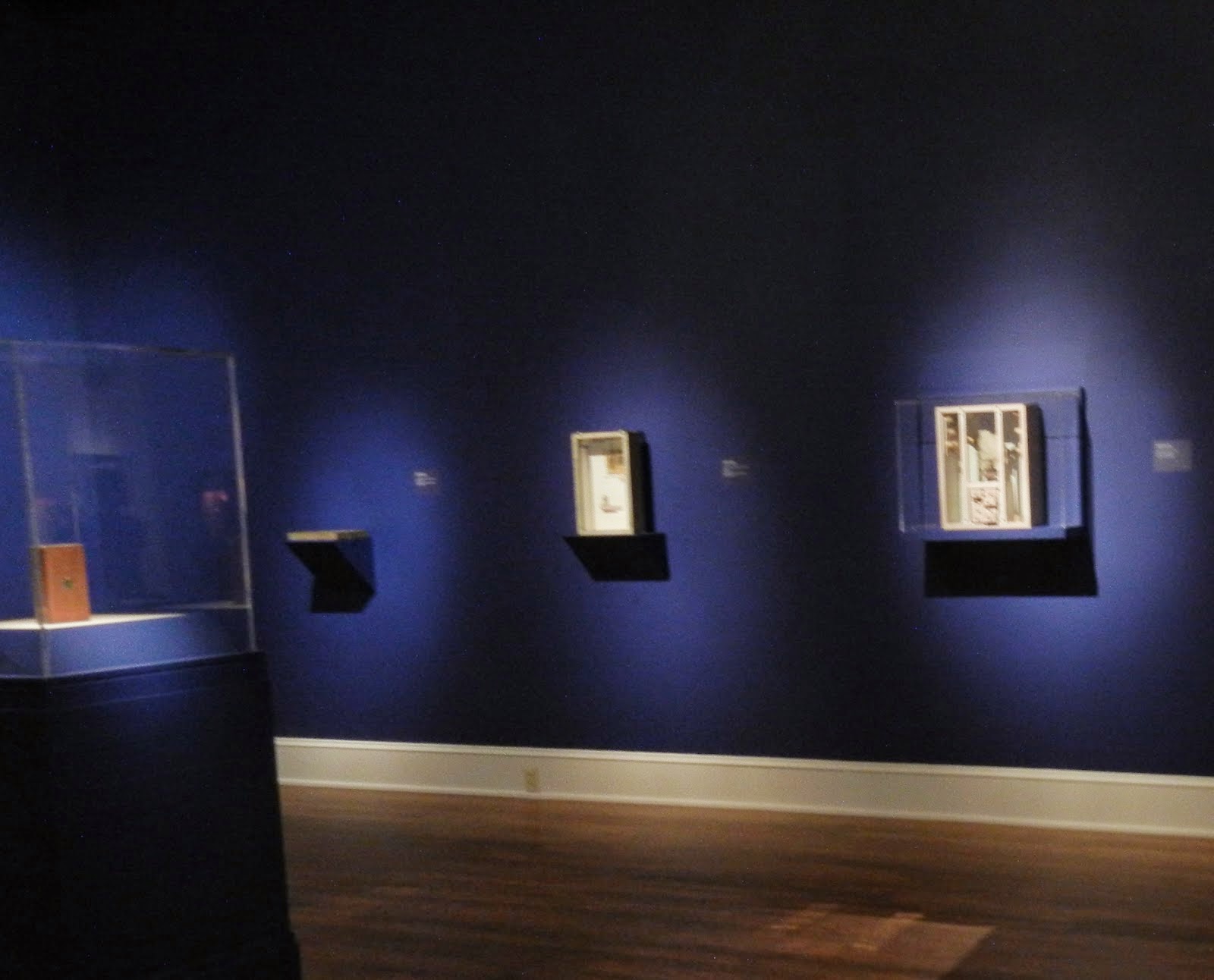
A few weeks back we went down to New Orleans to see friends, and Bill and I went to the New Orleans Museum of Art just to go there.  We stumbled onto one of those beautiful, serendipitous experiences that only happens when you don't make checklists or plans.  In 2012, NOMA refashioned their collection of Joseph Cornell shadowboxes, collages and dossiers into a self-contained universe with dark blue walls and intergalactic spaceship lighting that allows Cornell's world to sustain itself as both playfully serious and transcendently whimsical, a rare concentration of his works that allows you to quiet yourself down long enough to understand he was probably one of the greatest artists of the 20th Century.  And not because he was a part of a trend or reflected the turbulent times he lived in or whatever, but truly because he found a way out of all of that, and into a poetic century all his own.  He was making places for himself to escape to, dreamlands constructed from cracked window-glass and old toys, white-washed lavatory doors, forgotten wire in a junk-drawer, cobwebs in a corner crystallizing into words and phrases that never get said just evoked, unspoken yet vibrating.  The room of his work at NOMA opens up into its own versions of shadowbox intimacies; you want to go to sleep inside each of his pieces, find the dream he was dreaming the moment he made each one.  He was one of those people who could not find any other way out of himself other than through recognizing what he craved and fetishizing it into his own self-made religion, worshipping hotel corridors, magic tricks, sand on shoes from the beach, postcards inside shoeboxes, mystical moments you have that always go unsaid, that intricate form of daydreaming that allows you to find a whisper even inside a hive of bees.  He was a master storyteller who found epic narratives within empty pill bottles; he found hope in paint chips and discarded envelopes.  I kept walking back and forth among the pieces there at NOMA, not wanting to know titles or dates, but just luxuriating in the fact that they have been so beautifully preserved, tiny interstitial sentences, images, objects, minutes, days, all of it self-contained, an apothecary of jelly-jars and moonlight, misery unraveled by tenacity and determination.  Joseph Cornell knew what he was doing every step of the way, those collages and shadowboxes let us know:  he found his way through by working everyday of his life on a project he could only see one small puzzle-piece at a time. 
 

Friday, January 2, 2015

Some Playful Soul Shows up with a Bucketful of Piranhas

 
Thomas Pynchon writes like a great big dumb-ass, and I love it.  Often touted as a postmodern stylist and just as often derided as an emperor without clothes, he writes with a strange reptilian gusto that allows each novel to be totally hot and totally cold at the same time.  Every writerly move he makes seems arbitrary and yet preconceived, intelligentsia-stylized but also urgently infantile, smart but totally silly, funny-haha and not-so-funny-weird.  I've read every book he's published because I truly love the worlds he makes, and the distinct flirty mannerist folly all his books seem to go after.  He's not interested in "fiction" or "characterization" or "plot" or anything of that bull-shit.  He's looking for a way out while also reveling in the shimmery nonsense he churns out sentence after sentence.  His best book, the one I just reread in anticipation of the Paul Thomas Anderson movie based on it, is Inherent Vice.  It is his perfect dumb-ass masterpiece.
 
The story is like a Quinn Martin production, all private-investigatory flourishes parenthesized by pothead exhaustion and pornographic sex scenes and the sadness of the sixties hitting the seventies with a great big whimper.  Everything is hazy but the words he uses to describe the haziness are sharp as knives, a zoom-zoom vernacular from Laugh-In, Dark Shadows, and 1970 soap operas merged with a Saul-Bellow arrogance along with a sweet hint of forgiveness provided by a love of total losers.  Laugh-out-loud hilarious most of the way through, the whole book has an atmosphere of privacy being invaded by questions that can't be answered, a swirl of neon and ice cream and palm trees and concrete and acid and bullet-holes, like a James Rosenquist painting turned into a verbose puppet-show.  It ends so beautifully there's an ache but it also flails and fractures all the way through so that as you coax yourself toward that ending you give up trying to understand what's going on and enter into a Pynchonian coma, comfortably numb and also a little pissed off.  And yet still that ending has lyrical finality, a shut-lid on Pynchon's strange brew full of jokes and sinister tensions and silly little asides that never add up but then add up when you're not thinking about things adding up. 
 
Here, close to the start of the book, he's describing Hollywood right after the Manson murders (which play an inherent role in Inherent Vice's overall schizoid thematic structure):
 
“Odd, yes, here in the capital of eternal youth, endless summer and all, that fear should be running the town again as in days of old, like the Hollywood blacklist you don't remember and the Watts rioting you do - it spreads, like blood in a swimming pool, till it occupies all the volume of the day. And then maybe some playful soul shows up with a bucketful of piranhas, dumps them in the pool, and right away they can taste the blood. They swim around looking for what's bleeding, but they don't find anything, all of them getting more and more crazy, till the craziness reaches a point. Which is when they begin to feed on each other.”    
 
Wow.  The metaphor bleeds, right?   But it's chaotic and vibrant enough to gain steam, until it's sort of a joke, sort of not.  
 
PT Anderson cast Joaquin Phoenix in the role of Doc Sportello, the private-dick at the center of the Vice tornado/revelry/big-sleep, and I think he'll work because he's got a long streak of dumb-assed-ness all his own to pull from.  (And that, fully formed and perfectly executed dumb-assed-ness, is truly Pynchon's major gift to readers, the nonsense of the gods, first truly and grandly conjured in his penultimate tome, Gravity's Rainbow, which is loftier and heavier than Inherent Vice, but does a lot of the same things, only with a lot more grimness and determination.  You might even code Inherent Vice as Gravity's Rainbow Lite.)  Phoenix's off-kilter countenance and need to be methody is perfect, because that's kind of a Pynchon gig as well:  the egotistical freak-out guest on a Letterman episode spliced with Johnny Cash on Benzedrine, down-home funk and spectacularly self-aggrandizing stunts, full-on American glory built for the ages.  Yup Phoenix will do. 
 
In conclusion, Inherent Vice is fucked-up, stupid and brilliant.  Thomas Pynchon is Evil Knieval.  Let's hope PT Anderson gets the joke.
   

Tuesday, December 30, 2014

Candide Camera


Last night we watched all eight episodes of the second season of The Comeback in a row.  It was worth it.  The last couple episodes, prior to the finale this past Sunday, felt to me as if Valerie had jumped the shark, into a territory close to a John Cassavetes movie spliced with a very special episode of Facts of Life.  The parking-lot meltdown between Valerie and Marky Mark went on way too long and brought up issues that didn't seem dramatically and thematically earned.  Also Mickey's illness was becoming a little too much of a standing joke, something to tap into when scenes seemed to be going South.  
 
But then Sunday that beautiful finale happened. 
 
When Valerie decided to leave the Emmy's to go to Mickey in the hospital, The Comeback transcended its own apparatus, and that necessary break from the reality-camera-crew trope allowed me to mentally revamp what the show is and means and has accomplished.  I mean I've loved Valerie and her big bag of bull-shit since the beginning, but those eight shows in a row last night really seemed to illuminate the fact that Lisa Kudrow has created in Valerie a character that transcends her medium:  Valerie is beyond cool, beyond satire, beyond dramedy, beyond HBO.  She's the female equivalent of Voltaire's Candide.     
 
Bam.  Chew on that.
 
Published in 1759, Candide is a picaresque, sardonic novel about a guy named Candide, a naïve, good-hearted young man who through the course of the plot discovers that optimism in the face of horrible tragedy doesn't really work; in fact it makes things a lot worse.  Voltaire's triumphant satirical skills are effusive and hilarious, and yet there's a sadness under-girding the whole enterprise.  We don't really want Candide to lose the part of himself that allows him to stay hopeful, and yet the whole novel's purpose is to critique and complicate "hopefulness" in an effort to get a more actual and verifiable and truthful "truth."  Candide witnesses debauchery, earthquakes, and other horrors, on his way to an education that becomes more about understanding the world (and himself) than about how wonderful the world is. 
 
Like Candide, Valerie is naïve and good-hearted and kind of stupid, always on the lookout for her own redemption, which for most of the series comes in the form of fame and notoriety.  Her optimism stems from her need to be successful, and she spins every humiliating encounter and failure into a "lesson" or in many cases an outright lie just so she can feel better about her situation, and the world she's living in.  She is steadfast in her belief she is going to make it, to the point that "making it" loses all meaning.  But in the second season of the show, she actually does "make it," and she wins an Emmy for portraying herself as a dragon-mother-monster (as written by Paulie G, her nemesis/catalyst).  Then that win becomes meaningless in the face of tragedy (Mickey rushed to the hospital, as well as Marky Mark leaving her for the Palisades).  She rebukes all that self-indulgent optimism, that false hope of fame/awards/ass-kissing, in order to figure out what life means.  
 
So all my internal bellyaching about shark-jumping melted in the face of that pivot the show made in the finale, when Valerie says goodbye to Jane and Billy and the whole Emmy Awards audience, and joins the land of the not-real-but-real.  She breaks the fourth wall at that moment, and the show loses its reality-show machinations for the last ten minutes or so.  We see Valerie somehow resplendent even in a soggy evening gown, even in a hospital room with her flamboyantly gay and morally superior hairdresser...  She becomes a real person once she is no longer a real person. She gets her husband and her groove back. 
 
The satire in The Comeback, like the satire in Candide, is mean-spirited enough to do damage and yet sophisticated enough to heal.  That sensibility is nowhere else in television or movies.  I miss it already.

Saturday, December 20, 2014

Surrender


Bennett Miller's Foxcatcher is a true-crime fairy-tale that is all over the map tonally.  It does a strange dance across that map, moving from balletic/animal-grunting/brother-bonding/wrestling homage to chilly thriller about the frozen inarticulate seas between certain classes of men to a homoerotic plunge into lalaland to finally an examination of a love triangle that has no geometry to it, just a sort of lonesome collection of angles and points that end up cutting everyone into pieces.  Chiefly it's about Mark Schultz, a 1984 Olympic-gold-winning wrestler whose brother, David, coaches him; John Du Pont, a rich crazy freak in the mold of Mr. Burns, contacts Mark to become his mentor in 1987, and eventually both David and Mark get caught up in Du Pont's fever-dream of self-delusion.   
 
At the start of Foxcatcher, Mark is giving a speech in front of some bored middle-schoolers, after which he receives a twenty-buck check written by the school secretary.  The whole enterprise feels totally sad .  After he cashes his check he goes home to his lonely apartment, eats Ramen noodles with hot sauce, and stares into space.  Mark is played by Channing Tatum, and it's Tatum's movie from start to finish.  The broody wordlessness that Miller turns into mood and scenes is overseen by Tatum's muscular, stony sorrowfulness that can't be exorcised outside of a wrestling match, outside of grueling training.  At times, Mark becomes so frustrated he starts hitting himself, punching his cheeks and forehead out of sheer frustration, and Tatum accomplishes these scenes without losing a sense of innocent abandon, a sort of ecstatic freedom born of self-flagellation, as if all he were meant to do on earth is beat himself to a pulp.  Tatum is definitely a movie star here:  he carries this movie through sheer commitment to a seemingly one-note part that cracks open into a world of heartache and isolation.  There's no redemption, just performance.
 
Speaking of which:  presenting Steve Carell as John Du Pont.  Carell's performance is helped along with a prosthetic nose and a pallid makeover that gives him a grim and yet almost glossy countenance.  He's like a monastic wicked witch, but also there's something of a lost and totally sad little boy uncurling constantly in his glassy eyes.  Carell does comic work here that can only be funny in this way because it's ensconced in tragedy.  His Du Pont slinks into the wrestling gym like a Will-Ferrell SNL character (remember that pretentious professor in the hot tub?), all glorious self-involvement and awkward arrogance, but also Carell, like the movie, lurches between caricature and total precision, and by the time the movie is through you don't necessarily understand why he does what he does, but you believe it all.  The laughter is part of the whole she-bang.  I put a picture of the actual Du Pont up top, and there you go:  he's Nosferatu getting arrested, right?  That's the gig here, a look into the sordid machinations of a super-rich mofo who seemed torn between sexual jealousy and sexual repression, aching for friendship, yearning for more, and yet unable to connect with anyone outside of his own implied social power structure.  Carell's best scene in the movie occurs when he tries to put on a big show in front of his ailing mother in her wheelchair (played with icy regal grandeur by Vanessa Redgrave):  all the wrestler he's bankrolling are ordered to sit on the floor while he stands above them awkwardly pontificating.  In the middle of his speech, his mother quietly orders her accompanying nurse to wheel her out of the room, obviously disgusted with her son's inability to do what he thinks he's doing.  He looks on with both frustration and surrender.  He owns the plantation after all, and when things don't go his way he seems to feel he has the right to kill what he considers his property.
 
The property he kills is Mark Ruffalo's David, Mark's older more attuned brother, who moves to Du Pont's Foxcatcher compound to coach the team (including his brother) Du Pont takes to the Olympics.  Ruffalo is  the normative hypotenuse of the triangle.  He's not the apple of Du Pont's eye; he's a tool Du Pont is trying to use to torture Mark psychologically, bringing him into the fold in order to solidify their relationship.  Ruffalo's brotherliness and kindness are so needed in this thing, and he accomplishes it all effortlessly, to the point you wonder why it all has to end the way it ends, with a totally banal shooting in front of a snowy little house.
 
The movie is all about a sort of glittering banality.  It takes true-crime into a dreamy world of fixation and realism.  It's probably one of the most precise evocations of the late 80s I've ever seen on screen, and not because it tries to evoke nostalgia as much as capture a mood of soft-lit devastation and fuzzy TV light and gaudy riches, all of it rolled into a hellish episode of Lifestyles of the Rich and Famous. You leave this movie not edified or fulfilled.  It's more like you're waking up from some beautiful, horrible nightmare closer to real life than nightmares should ever be.

Saturday, December 13, 2014

School Daze


Tuesday this week I got to visit some public schools in Hamilton, Ohio as a part of this Chamber of Commerce Leadership Training thing I'm in, and it was inspiring in a way I didn't think it would be.  I'm in this class with business leaders and non-profits leaders and sometimes I feel a little out of my element, but still there's a feeling among all of us I think that we just want to see how things work, and what their worth is. 
 
What truly touched me, though, was visiting this small elementary school out in a residential neighborhood in the middle of nowhere.  The principal there was hyper-cordial and super-excited in a way that didn't feel phony, and as we walked in the little kids there sang Christmas songs and they gave us hot chocolate.  It sounds corny as hell I know, but somehow it wasn't.  And as I got the lowdown on what the school is about, it made me think that the principal was truly curating the school's activities and identity and mission, as opposed to just running a school.  She seemed focused on making sure the kids that go to the school, and their parents, have as many opportunities as possible to explore what learning is, and also what life is.  They have taken the back few acres behind the school and transformed them into an "outdoor classroom," replete with log-stools and open-air nature-viewing areas.  They have a backwall of windows that the kids use for bird-watching, and have connected that ornithological exercise with some scientists via the Internet so that what they are accomplishing is more data collection that just plain old in-school activity.  We visited an art class filled with first-graders who had drawn crazy-looking monsters, and those drawings had been transformed into three-dimensional ceramic monster-dolls by some local high school kids, and some fourth and fifth grader were now assisting the first graders to write stories about their monsters, all culminating in an art-show at the local arts center next year.  We went into a math classroom where they were playing a gameshow based on learning percentages, a big wall-screen filled with phosphorescent gameshow graphics framing long rows of numbers.  Lots of sound effects and giggling and the kids totally in it to win it.  There was a sweet energy in the air, and even though it was partially because they were doing a dog-and-pony routine for the Chamber of Commerce Leadership thing I totally felt like this was just a day in the life, and that all the teachers and administrators and helpers and kids were doing what they wanted to do, only heightened because of being able to show off.
 
At the end, all of us were given gifts.  Mine is above, a red ceramic bowl I just took some photos of.  It's an object that really is a sort of icon, symbolizing something deep and simple.  It's beautiful because it comes from a really good place, that little school with its backyard woods and gameshow math classes and first-grade magic-marker monsters.  And I'm thinking maybe that school is more of an art gallery or art museum than most galleries and museums that try so hard to be galleries and museums.  The function of that school feeds the style and form; the energy comes from the art being used to make something better happen, and that sense of hope makes that little red ceramic bowl kind of glow.  It's a flower, it's a toad-stool, it's a monster's brain.  It's handmade and shiny, virtually nonexistent and yet purely what it is.  A lot of artists reach for that when they make their stuff, but can't find it because they want to conjure instead of produce, want to make something fine when they should just make something feasible and there.  That's where my heart is, I guess, when I look at art now:  I'm always trying to find that silly little red bowl in paintings and sculptures and performances and drawings...  That is the center of the universe somehow, something given to a stranger without knowing where it will go, all good intentions, no secondary need for attribution or even acknowledgment.  It hardly ever happens, me finding that moment, that purity, that whatever.  I saw it last year at the Mike Kelley retrospective in New York City.  I see it sometimes in the works we show at Thunder-Sky, Inc. and the shows at Visionaries + Voices.  But it's totally best when it just comes out of nowhere, not a surprise as much as a reprieve.
 
Back in 1961, one of my favorite artists, Claes Oldenburg, wrote a manifesto called "I Am for an Art..."  Here's part of its beginning mantra:

I am for an art that grows up not knowing it is art at all, an art given the chance of having a starting point of zero.
I am for an art that embroils itself with the everyday crap and still comes out on top.
I am for an art that imitates the human....
I am for all art that takes its form from the lines of life itself, that twists and extends and accumulates, and is heavy and coarse and blunt and sweet and stupid as life itself.


That's a great description of what I felt at that little school on Tuesday, that sense that art happens in the most secret and mundane places and we don't have to see it for it to exist.  We just have to recognize it when we have the honor and opportunity, and then move on. 
 

Friday, December 12, 2014

Just Wanted You to Know

 
We got off I-75 at Corbin, Kentucky, and right there is David's Steakhouse and Buffet.  Neon "choice steaks," a long brick ranch-style, a comfort.  As soon as you go in, they say howdy and it's not forced.  It feels like they really want you to be there, like church except less creepy because it's not church.  And you get your tray and they ask you what drink you want, and that smell of steakhouse-buffet, pleasant mix of dishroom bleach-water cutting through gravy vapors, fried-food phantom exhaust and spice-cake lit with 100-watt bulbs.  It's dark and homey in here, back-window glimmer and fluorescence combining into nursing-home kindness.  The buffet spans out like the control-panel in a great big spaceship except overflowing with country food, and protected by multiple sneeze-shields.  It's heartening.  It does not hurt to be here.  Everyone is like me, except they wear a lot of camouflage and say grace before they eat.  A gentleman-manager asks what drinks we'd like.  I say Diet Pepsi, and he offers up, "We have Diet Mountain Dew now too.  Just wanted you to know."
 
We pay the teenaged boy running the register.
 
We find out seats in the back area, with a big wall-installed TV showing a football game.  Kiwanis and Little League plagues all over the walls.  Paneling and beat-down carpet and chunky wooden tables with steak-sauce bottles and napkins.  A couple waitresses over on the other side of the room rolling silverware and talking about the snow. 
 
I go and get what I want:
 
  • Meatloaf covered in catsup and tasting like what I used to eat back when food was like this, totally simple and tasting like food, so stupid and simple it makes you want to cry, like you are eating a part of a couch from your childhood, like you are eating a day in your own past life, like you are finding a way to remember something that doesn't need to be remembered and yet comes through so loud and clear it makes you want to cry.
  • Baked chicken with the skin still on, soggy, just the kind of soggy necessary to make you feel alone with it.  Baked chicken sort of greasy but clean tasting, fleshy and stringy and hot, and there's a non-sauce to it, what has baked off in the pan, that tastes like Campbell's Chicken Noodle soup, that smell of being sick and eating even though you are sick,  total comfort in the face of all that's wrong, and you not knowing where you are going to be or go.
  • Fried okra from a deep-fryer, that taste of dirty grease somehow a delicacy now, here, but still reminiscent of restaurant work in the South, what's left on a buffet when you close.  Slimy sort of once you get past the breading, but still a taste of summer in there, bland and green and boring and yet again here I am enjoying it beyond enjoyment, close to those tears.  Nobody is sitting near us.  We eat like a little ceremony, like we've rehearsed eating this way.  Plate after plate, beautiful robot-hillbillies. 
  • Greens cooked to the point of not being green, splashed with vinegar:  that's what I wanted right away, this.  Mossy, gamy, gorgeous green, watery, vinegary, like mown grass transformed into a taste you always taste when you feel homesick, or at least when you feel like you need a place to hide. 
  • Cooked carrots, boiled to their banal essence, cooked into contentment.  They taste like you're eating a sentence you said in 1979, when you wanted not to talk but somebody made you.  Orange, grainy, disappearing across your tongue.
  • Banana pudding.  Like a prayer in a Baptist church.  Like amnesia with banana flavoring.  Vanilla wafers are so lovely, symbols of loneliness in a small town,
That's all I got.