In a New York Magazine article about the recent opening of The Metropolitan Museum of Art’s Costume Institute's exhibit,“Punk: Chaos to Couture," Nitsuh Abebe writes:
"In music, punk remains what the critic Frank Kogan calls a “Superword”—a term whose main purpose is for people to fight over what it should mean, using it as a “flag in a bloody game of Capture the Flag.” It’s a concept like “freedom” or “the one true Church” or “real Americans”: to invoke it is to advance a vision of what it entails, and duke it out with competing visions. (Saying that real punk only lasted 100 days is a terrific example of how Superwords work.) In the 37 years since a good mass of people decided “punk” was a flag worth waving, we’ve seen countless versions of it, most at odds with one another. There’s punk that’s dissolute and nihilist, and punk that’s earnest and abstemious; punk as attitude, as economic model, as ideology, and as an ordinary subgenre of music; punk that’s funny and punk that’s humorless; Fascist punk and anti-Fascist punk; punk that sounds like 1977 and punk that can’t imagine repeating the past; you name it. If there’s any reason the stuff’s stayed in the bloodstream of rock, it’s that the idea is flexible enough to put anything into it, take anything out, and feel like you’re fighting the good fight—the word itself is mostly just permission to get into the ring."
Semantics becomes destiny in other words, and all the antics, epiphanies and realities get swamped by what we call them. "Superword" is a way to conceptualize that other weird little cultural red-headed stepchild: "outsider." Anytime I've ever been to an "outsider art" conference, fair or symposium, capturing the "outsider" flag is always of optimum importance, especially to curators and academics. It's like naming and claiming something becomes the something you're trying to name and claim, a magical alchemy that doesn't really deliver any help or insight, just fogs up the issue and makes you feel like you did something. A "superword" is just a way to give yourself a way to aggrandize what you feel, and in that "outsider" cultural void there really are no true winners. The artworld considers "outsider art" a sweet little nuisance at best, and outsiderness's representatives and apologists become predestined wannabes. They end up squabbling at the kid's table at Thanksgiving.
So why not get rid of the whole damn idea?
Because, I guess, if you don't name something, if you don't claim it as "something," then it becomes what everybody already seems to think it is: nothing. You have to figure out what an artist who doesn't have a pedigree, who does not have access to museum-ness and professionalization, but who does have talent and energy and motive -- you have to find a way to push them into the spotlight, not so you play the "capture the flag" game, but so they can prove to the world what they are made of. And that means you probably have to get rid of the superwords that are in the way, while understanding that the real game is outside of the outsider realms, outside of semantics, outside of superwords.
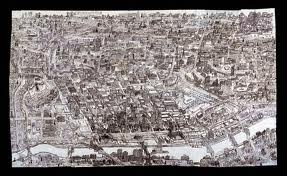
That's what's so great about Courttney Cooper being in a two-person show at the Cincinnati Art Museum, coming up in a couple weeks. (Thanks to Matt Distel.) I'm working on another essay about Courttney and how I met him and was the first person to introduce him to Visionaries and Voices, the art studio I, along with a bunch of other people, pulled together back in 2003 to support -- yup you guessed it -- "outsider artists," mainly those with developmental disabilities. I'm trying to do this essay without using "superwords," and without aggrandizing myself and the organization I helped cofound. I think Courttney used V+V in a way that allowed him to be above the fray and yet exactly at the center of it. He expanded his mode of operation because there was more real estate. V+V had a big table that he could stretch out on, and his repertoire grew because of it. His deeply personal and astonishing drawings of maps took on an epic scale because he had a place to go to do it that allowed him to expand, that cheered him on. (Plus V+V was just down the block for him.) This happened because he had a disability and V+V was created to help him, but I'm thinking whether or not V+V opened Courttney still would have found a way to create his art and what he needed to happen. It's because of his intense talent and drive; in other words, and these aren't super at all, Courttney is an artist not because he has a disability or because he goes to V+V or because of anything other than the fact that he himself willed himself into being one. When you place some one's spirit and talents into the realm of "superwords," it's easy to forget that. Courttney is an artist because he wants to be. He needed to be.
Above is a blurry photo of an object Antonio Adams created back in 1999. Like Courttney, Antonio is one of those "outsider" artists that can't be "superworded" to death. That little green felt pillow in the bad photo was something he made in high school, and it has a precious yet somehow intentionally/unintentionally smartassed quality. It's an exercise in punk in many ways, and it gave birth to this whole thing truly: we named the whole project of pulling together a studio for "outsider artists" The Art Thing Project (before coming up with the V+V tag for a grant proposal) based on the simple, silly, yet very intelligent little object Antonio created out of nothing except a sort of desire to conceptualize what art is. An "art thing" dislocates superwordiness. It gets rid of the clutter. All artists, outsider or insider or in between, make "art things." All artists dream up little green felt heart-shaped pillows the size of the palm of their hands, execute the production of it, and then just look at the thing, wondering why they did it, and yet rejoicing in the afterglow of doing it.
"Punk" and "outsider" coalesce in many ways. Both are cultural movements that are disorganized and yet somehow here to stay because we need concepts that counteract our complacency and snobbery. In-house arguments about meanings take away from the actual reason the concepts were created in the first place: to pull people's heads out of their asses so they can see and hear and feel incredibly new and great stuff made by people they usually see fit to ignore.
On with the show....