Tuesday, December 17, 2013

anomaly, noun (pl -lies): Deviation or departure from the normal or common order, form, or rule.


Thunder-Sky, Inc.'s 2014 Exhibition Season: Anomaly Lessons
 
Thunder-Sky, Inc.'s 2014 exhibition season includes paeans to an idiosyncratic fiction-writing genius, a local hat-wearing folk hero, and other wonderful outcasts, including Mr. Thunder-Sky himself in a season-ending installation that incorporates his desire to build a Utopia while destroying whatever got in his way. We're using "Anomaly Lessons" as the organizing concept and title for a whole year's worth of shows that teach us all what it means to be gorgeously abnormal.
 
"Head Shots: Portraits by Bob Hoke and Stacey Vallerie" opens January 10, 2014 with a reception 6 to 10 pm. The show closes February 14, 2014. Hoke, from Hannibal Missouri, creates whimsically bizarre and bizarrely whimsical portraits of people with a Paul-Klee flourish; Cincinnati-based Vallerie finds inspiration and serenity in reality. Side by side, their works seem to whisper sweet nothings to one another.
 
"Deep in Thought: Paintings by Mark Betcher and Scott Carney" opens February 28, 2014 with a reception 6 to 10 pm. The show closes April 11, 2014. Northern Kentucky's Betcher layers his work with words, pictures, and word-picture hybrids; Carney looks for Utopia in his storybook paintings.   Both approaches feel thoughtful without belaboring the point, both visually appealing and a little off-kilter.  
 
"Rejoice!: A Retrospective of Avtar Gill, the Cincinnati Hat-Man" opens April 25, 2014 with a reception 6 to 10 pm. The show closes June 13, 2014. Avtar Gill (pictured above), known by many downtowners as The Hat Man, passed away early 2013, but he will always be remembered (like Raymond Thunder-Sky) as a Cincinnati folk hero for the sign-emblazoned hats he wore while walking all across the city, and for his dedication to maintaining a strong, cultural voice and presence throughout his life. This exhibit will feature photographs, video, testimonials, stories, and actual hats and signs The Hat-Man left behind.
 
"The Meanest of Them Sparkled: Visual Artists Respond to Flannery O'Connor's Fictional Universe" opens June 27, 2014 with a reception 6 to 10 pm. The show closes August 8, 2013.   "Meanest" commemorates the 50th anniversary of Flannery O'Connor's death. A skilled, humorous, dead-on writer of short stories and novels ("A Good Man Is Hard to Find" and Wiseblood chief among them), O'Connor's prose is steeped in beautifully unsettling images and set-pieces. O'Connor was a painter and cartoonist besides being a fiction-writer, and this sensibility informs a lot of what she wrote and depicted. We've asked several artists to create art inspired by O'Connor's genius, no limits on media or style. We'll also be sponsoring a reading of some of O'Connor's works to go along with the show.
 
"Outcasts from Hollywood (the Greatest Celebrity Art Show Event): Antonio Adams and Emily Brandehoff" opens August 22, 2014 with a reception 6 to 10 pm. The show closes October 10, 2014. Adams and Brandehoff often work side by side on Saturdays in the basement at Thunder-Sky, Inc. They will be creating separate suites of work that investigate/celebrate/satirize the poetry and absurdity of celebrity culture and its aftermath. "How Deep Is Your Love," a Thunder-Sky, Inc. fundraiser happening in the basement gallery, opens as well.
 
"New Clownville Amusement Park: Constructing Raymond's Perfect World by Matt Waldeck Jr. and Sr. and Marc Lambert" opens October 24, 2014 with a reception 6 to 10 pm. The show closes December 12, 2014. The Waldecks (a father and son team), along with Lambert (whose painting of Raymond is above), are taking over the gallery to create a Raymond-Thunder-Sky-inspired installation that pays homage both to his drawings and to his life. Sculpture, drawing and other media will be on display. As well, we'll be presenting a new show of some of Raymond's more obscure and eccentric drawings. 

Saturday, December 7, 2013

The Good Chief


The Good Wife is a TV show on CBS I always heard about but never watched because it seemed too taken with itself in ads and in what little bit and pieces I heard and read about it.  It came off smug and self-satisfied, a complete one-note concept (a lady whose politician husband cheats on her so she goes all independent on him and gets a job at a great big law firm) that didn't even seem worth a Lifetime movie.  But it turns out I was wrong.  Totally wrong.  I started watching the fifth season of The Good Wife on a whim, out of boredom really, and every episode I've seen On Demand is so polished and revved-up and smart I couldn't stop from bingeing big-time.  The show has a Shakespearean pulse to it vibrating beneath the lawyer-mahogany veneers of office furniture and desperate, processional middle-aged faces.  At this juncture of the show, Juliana Margulies' Alicia Florrick, the good wife, has decided to jump ship from the big firm that allowed her to go all independent on her no-good politician husband's ass.  She is in cahoots with the "four years" at the firm, all hyper-ambition attorneys with a penchant for lattes and stealing clients.  The atmosphere of the whole she-bang is what is thrilling.  The music has a Philip-Glass pretentiousness that never lets up and every scene never swerves from its purpose until it lands right into your brain with a perfect little finish.  The writing is exquisite, and even though I truly fucking hate the word "exquisite," that's the only descriptor.  The acting, as well, is exquisite.  Margulies is cryptic, beautiful, conniving, bitchy, and nurturing all at the same time; a sphinx-like graveness emanates from her like a halo, but she's no angel and no sphinx.  She truly exists in a real world with real problems, but her ambition and desire for making her work great gives her a power and presence you just want to succumb to.  The same can be said for Christine Banaski's Diane, a co-founder of the firm Alicia leaves, whose spot-on professional-lady drag is both poignant and ferociously there.  Baranski gives Diane a strangely touching vulnerability.  You can see her second-guessing all the crap she has to do to stay in the game while also experiencing the overwrought joy of having something powerful and sketchy to do as well.  All of that empathy and snideness gets synergized in Baranski's gaze, a glass-doll permanence that melts when no one is looking.  Or when someone is looking and she wants to trick them into thinking she thinks no one is looking.  The third lady in The Good Wife's Holy Trinity of Ambitiousness, possibly the Holy Ghost, is Kalinda Sharma, played by Archie Panjabi, the law-firm's in-house private investigator, who silky/steely countenance and reserve somehow give her the grandeur of a Christopher Nolan superhero.  She carries with her at all time a little private notebook she uses as a sort of force-field and a symbol of her dedication to remembering everything people do to hide what they do.  The Good Wife is about truly about work, and how work can both give you a reason to live, as well as a reason to want to kill yourself, and in that odd mix of desire for greatness and the desperation of knowing you're not really that great the characters and plots in the show work themselves into a frenzy that is so glossed and preened you can almost miss how dangerous it all is.  That's a good thing.  The drama is a radioactive afterthought. 
 
Treme is a TV show on HBO I also always heard about but never watched because it also seemed too taken with itself in ads and in what little bit and pieces I heard and read about it.  Created and produced by David Simon, the guy who did The Wire (one of those other TV shows I have hear a lot about but never watched because...), Treme seemed a little to precious and earnest.  But since we had a magnificent stay in New Orleans last month, and since I stumbled across HBO on Demand and saw the word "Treme," I went ahead and partook.  Unlike The Good Wife, Treme's pace is slow and dedicated to its own slowness.  The Good Wife has a zippy, nervous elegance; Treme has a Dickensian stubbornness that somehow works itself out in the way the actors create tension and momentum among themselves.  Clarke Peters as Albert "Big Chief" Lambreaux is one of the main reasons Treme is magical.  He plays Big Chief with a sort of offhand yet tremendously magnetic gravity.  The whole thing is about is about New Orleans recovering after Katrina.  It starts three months after the devastation, and Season One, which I just finished, shows us folks like Big Chief returning to mud-covered front-porches, mold-covered walls, and a city without a basic infrastructure to live in.  And yet Big Chief gets right back to it:  creating the costumes that he and his tribe will be wearing in Mardi Gras.  Mardi Gras "Indians," it turns out, are a true cultural configuration, groups of African Americans creating Native-American-esque costumes and then parading around in contests and sometimes combats concerning who is the "prettiest."  These costumes are supernaturally gorgeous, all Technicolor ostrich feathers, hand-sewn bead-work, etc.  Watching Big Chief and his friends and family creating those costumes in a half-destroyed tavern is like stumbling across a fever-dream fairy-tale that's never been told before, and yet unlike a fairy-tale there's a political urgency and rage being played out.  The music, as well, plays a huge role in the show, and one of the other main reasons to catch Treme is Wendell Pierce as  Antoine Batiste, a trombonist constantly on the search for gigs whose face and eyes carry so much inwardly acquired super-power from all the shit he has had to go through it's almost comical and yet not funny at all.  Pierce is brilliantly at home in the role.  He feels so right I almost burst into tears when I watch him play or just even speak.  The same goes for Khandi Alexander as Ladonna, Antoine's ex, who is now married to a dentist in Baton Rouge but who keeps her family's bar open in Treme because she has to in order to remain sane.  Alexander gives Ladonna a grace and fierceness almost akin to the queens in Paris Is Burning, a meanness and dedication that keeps herself and others alive.  There are so many other reasons to watch Treme that I really can't go into them without having to write a novel.  John Goodman's enraged, hurt, dumbfounded professor, Melissa Leo's brilliant, befuddled, joyful civil rights lawyer (and Goodman's professor's wife), Steve Zahn as an impassioned hipster, Kim Dickens as a chef trying to maintain whatever semblance of order is left to be had...  Everyone in the show is brilliant and yet what you get out of it is a spirit of a city trying to feel its way out of doom.
 
The Good Wife and Treme both celebrate without sentimentality or irony what it means to work.  "Working" in both contexts is a way people survive in all sort of ways, not just economic.  These two hour-long dramas locate reasons for existence in what we do everyday, trying to make a living without losing the reason we want to be alive.  Both The Good Wife and The Big Chief have piercing, enigmatic stares, as if they are scanning for traitors while also looking for their next redemption.      

Sunday, December 1, 2013

Hive Minds


Valentine Road is a documentary about the death of Larry King, a fifteen-year-old boy who liked to dress up in make-up and high heel shoes and go to school.  He was shot in the back of the head by Brandon McInerny, a fourteen-year-old peer, because of that, and also because Larry told him he wanted Brandon to be his Valentine.  This happened in 2008 in Oxnard, California.  I didn't remember this incident at all, but in Marta Cunningham's film she shows us the media taking on the issue (Ellen DeGeneres gives a wonderful plea on her show, among others), but that isn't really the point for Cunningham.  She's interested in showing us how these events are a lot more complicated than speeches on talk-shows can allow, more complicated than most people can even accept inside their own minds.

Watching this documentary I felt mystified a number of times by the overarching meanness and judgment in people's faces as they spoke about Larry and how he somehow caused his own death by his "eccentric behaviors," and I was also taken aback by the sweetness and sorrow in the facial expressions of the murderer and his immediate family.  It's a dizzying feeling, this movie, because while her heart of course is with Larry and what was done to him, Cunningham does not shy away from looking into the heart of darkness that helped to create the situation.  That darkness is located in many places within the context of the film, including school hall-ways, white-trash front-yards, middle-class dining rooms, foster-care facilities, and eventually a courtroom.  The darkness, in fact, is the point here.  It is a darkness so dark that it creates a sort of confusion that's masked as compassion in many people's hearts. 

Larry's desire for Brandon is constituted as a malfunction of a grievous sort by many of the teachers who used to teach Larry (one of the bitchiest ones in the documentary cites the fact that Larry was on an IEP and "behavior program" as evidence for his need for "correction" and "conversion"), and many others, including an evil older teacher stirring her iced-tea with a knife in her plush crucifix-decorated split-level, state that if Larry had been told how to act, and punished for acting out in high-heels, the situation, the murder, would not have taken place.  It's scary to think that these women (all of Larry's teachers happened to be women) and others lack the imagination and the moral apparatus to understand how Larry's love for a boy, and his happiness in both dressing like a girl and expressing that love, should not damn him to being shot in the head.  It's pretty easy math, even when it's overtly sentimentalized.  But something about Larry brings out the beast in people, and not just Brandon, but a whole society.

This society includes the jurors in Brandon's trial, which eventually ended up with a hung jury.  In Valentine Road we are privy to the after-trial thoughts of three ladies who were part of that hung jury.  These woman are heavily made-up, talking about how astonished they are at the low price of Cabernet at Trader Joe's as they swill it at a suburban dining table laid out with pastries and cheese and crackers.  An off-kilter chumminess has enveloped these three in a sort of tribal bitchiness as they talk about how Brandon really had no choice because of Larry's sexual harassment, how no adult stepped in to ensure that Larry would stop breaking the rules...  Their collective sympathies for Brandon, the killer, are breathtakingly nonchalant, as if they are discussing someone playing hooky.  It is both creepy and awe-inspiring, their lack of any kindness toward Larry.  They only see him as a thorn in Brandon's side, an obstacle to his future now.

Larry was a foster-kid.  Larry had no connection to the world outside of a few friends at school, and the one teacher in the film who felt compassion for him and who was actually with him in the computer lab when he was killed.  (She was summarily fired from her job because she gave Larry her daughter's prom dress to wear.)  Larry was an anomaly beyond abnormal to the majority of the people who were charged with educating him  His mere presence, however, fucked with their need to correct, control, convert.

Mary Gaitskill is one of my favorite writers, and in September she wrote a nasty takedown review of Gone Girl, a popular novel that's gotten a lot of attention.  In the review, Gaitskill talks about some of the same issues Cunningham gets at in Valentine Road.

"So why is Gone Girl scary rather than kooky? Primarily the characters’ apparently everyday behavior—their motivations and how they view one another. Amy and Nick [Gone Girl's main characters) do not resemble actual people so much as grotesquely smiling masks driven by forces of extreme artifice, and it’s exactly that extreme artificial quality that’s frightening to the point of sickening.  What I mean by “artifice” is social language, styles, and manners, a public way of being that is by necessity coded, fixed, and hard, and which has become even more so through the emergence of the virtual world. In physical life, the hardness and (frequent) deceptiveness of such language is offset by the deep, doggishly honest presence of the body; in the virtual world, such animal presence is either absent or faked. Gone Girl doesn’t compare to other books so much as it evokes flipping through TV shows (including the news) and glimpsing face after chirping face, all with only slight variations on the same manner of speech and “smart,” high-speed delivery common to Facebook, texting, and tweeting; that is to say, the book evokes (impressively, one might argue) a hyperartificial, hive-minded way of relating, combined with what has become a cultural ideal of relentless feminine charm tied to power and control."

The teachers and jurors in Valentine Road who use Larry as a cautionary tale to any other freaks out there thinking they have a right to dress weird and tell people they love them are hive-minded and hard-faced, diligent in obeying some need to keep things static and coded and fixed and artificial.  That's what makes them "scary rather than kooky," and gives Valentine Road a moral imperative and its deep beauty.  In the middle of the movie, while they are chattering about "behaviors" and "sexual harassment," Cunningham cuts quietly to a picture from Larry's autopsy. 

She shows us the two bullet-holes in the back of his head. 
 

Saturday, November 23, 2013

Gag Gift

 
The other night I stumbled across The Wrestler on TV.  I remember seeing it at a Cineplex in West Chester, Ohio back in 2009, and halfway through it I had to get up and go to the restroom because I was crying so hard.  That doesn't happen very often.  I mean I cry at sad movies, but it's the normal wipe-a-couple-of-tears-off-your-face way.  The Wrestler sent me into spasms.  It had everything to do with Mickey Rourke's performance, as well as the director Darren Aronofsky's ear and eye.  The scenes were so devastatingly specific they crushed me in a way that only real life does, almost as if I had lived through them with Randy "the Ram" Robinson. 
 
It's very hard to depict working class trash in literature and in movies because there are so many traps and tropes and tricks, you can kid yourself into creating a stereotype while also feeling your doing the world a favor.  Aronofsky's gift is taking a cliché -- a professional wrestled completely down on his luck searching for redemption -- and recalibrating the atmosphere and action so that it has a haunted, lived-in feel that makes you believe this shit is more than real:  it's alive.  The scenes when The Ram works at a deli-counter in a grocery-store are so vivid and dead-on you feel embarrassed and elated simultaneously, as The Ram doles out fried chicken and potato salad in plastic containers with a Vaudevillian shuffle and a showmanship that he just can't drop, even if he is working minimum wage and recovering from his latest heart-attack.  And the scenes with his daughter have that same bruised tenderness, that sense that The Ram understands his own joke and yet can't stop telling it over and over and over to an empty house.  The daughter, played with a glum effortlessness that fits each scene perfectly by Evan Rachel Wood, doesn't want to see The Ram in her front yard, but there he is, stepping out of his white-trash customized van, offering her gifts, haphazardly wrapped in old Christmas paper.  First off he gives her a "gag-gift" to warm things up:  a lime-green 80s bomber jacket.  You can see by the look on her face what she's thinking:  business as usual.  But then The Ram gives her the actual gift, the real thing:  a Navy blue pea-coat that seems just like her, sensible and working-class and a little glamorous too.  That's one of Aronofsky's great touches:  allowing The Ram enough self knowledge to understand the situation he's in, without losing the authenticity of being exactly what he is. 
 
There's a stubbornness on screen that is not acted out; it's lived and somehow embedded in every move the camera makes.  That desolate working-class neighborhood where The Ram's estranged daughter lives is in both my dreams and in my history, that feeling of being lost and wanting to be found but unable to tell anybody where you're hiding.  And The Ram's trailer home too:  nasty but not too nasty, a place you can see yourself living if you had to.  Nothing is too much, and yet Aronofsky and Rourke capture the extremes to the point you feel them as a part of your own world.  No judgment happens.  There's a crystal clear connection between who you think you are and what you are seeing.
 
It's empathy, but without any sense of uplift or heroism involved.
 
In my stories I try to construct characters that live in the same cosmically disjointed and kind of dirty universe The Ram populates.  It's truly hard because if you think about who might end up reading them it gets a little screwy.  The artistry comes from not shellacking over faults and perversions and creepiness, but finding a way to make "sins" universal, implicating people in these lives with an effortless sense of connection and nonchalance.  Or as Flannery O'Connor puts it (and by God I'm using this quote as an epigraph for the new book of stories):  "It is when the freak can be sensed as a figure for our essential displacement that he attains some depth in literature.”  

Saturday, November 16, 2013

Workaholics Anonymous


The other night I was driving to the Thunder-Sky Gallery because we were going to have a meeting about how to best help people with disabilities access real employment, with actual living wages and a chance to move forward.  I had pulled together this informal group of likeminded people who actually do that, so we could talk shop and figure out how to negotiate all the systems and other forms of bull-shit that can impede the simplest and yet most arduous of tasks:  finding meaningful work. 
 
On the way there I got a call from a woman named Beverly, out of the blue.  She said she'd heard about Thunder-Sky, Inc. via an article online, and she was floored.  She was Raymond's job coach when he worked at M. E. Heuck, a company that makes kitchen utensils.  Raymond worked there for quite a while.  Beverly said that he had the strongest work ethic of anyone she'd ever seen.  "He was a true gentleman," she said.  "He was so focused on his work it was amazing to watch."  One time he came in off the bus looking roughed-up with a bruise on his eye.  Although he didn't talk too much, Beverly said she could tell that he had been mistreated probably by some teenaged boys.  "That kind of stuff happened a lot to him," she said.  Raymond, that day, just went right to work.  It was as if he was trying to work all the hurt out by staying in the routine. 
 
Everyone who really knew Raymond knew he was a workaholic.  All he really ever wanted was a good job, which often means also having a good life. 
 
Beverly said, "He really didn't need a job coach.  He could do the job.  But it was my pleasure to be able to visit him on the job when I did, just so I could talk with him and be in his presence." 
 
I got kind of choked up talking to her because it was one of those moments when things seem to coalesce, and those kinds of moments catch you so off-guard you almost want to hide from them.  We're always trying to think of the best way to continue Raymond's legacy.  The art gallery, and archiving all his drawings, is one way, but another way might be to figure out the best ways to help people like him get real jobs, and to put those best ways into practice all across the area.
 
So that night the group (we're calling ourselves The Believers and we're keeping it kind of on the down-low) met at his namesake gallery, and it was great.  People totally focused on the same issue talking about struggles and successes and also stumbling onto a sort of collective point of view:  the best way to help people is to get them working through connecting them with businesses and employers who need really good workers.  That sounds really simple, but in the over-complicated world of "helpful" bureaucracies that surround the lives of people with disabilities like creepy force-fields, this simplicity is often drained out so that every good idea gets stretched into a process that eventually yields nothing.  I know that sounds cynical, but that's it in a nut-shell.
 
How then do you decrease the bull-shit and increase the possibilities of real stuff happening?
 
Do it without making a big deal out of it.  Concentrate on one person at a time.  Concentrate on one or two businesses at a time.  Get to know both.  Find out what the person needs and wants.  Find out what businesses need and want.  Make the connections matter without a lot of fuss or process.  Just do it.  And then keep doing it. 
 
At the end of the discussion, we figured one of the best ways to make things happen is to keep doing what we're doing, and to meet regularly to compare notes and get new ideas from one another.  We also decided that each of us should invite one other likeminded person to come to the next get-together in January.  Grow slowly, keep each other focused, celebrate and learn from each connection we make.  Keep moving forward.  Don't let the need for bureaucracy and funding overrule the need for sanity and real accomplishments.  We figured that we use the system the way the system is supposed to be used by actually helping to make things happen, without enslaving ourselves to process and procedures.
 
I'll be inviting Beverly to the next one.


Sunday, November 10, 2013

And Who Knows What to Do with It?

This is from Tennessee Williams' Streetcar Named Desire

“Don't you just love those long rainy afternoons in New Orleans when an hour isn't just an hour - but a little piece of eternity dropped into your hands - and who knows what to do with it?” 

You-know-who trills that phrase and almost all of the other great, hyper-poetic, drowsy, gorgeous lines in Streetcar:  Blanche Dubois.  Sweet sad decadent ridiculous beautiful Blanche, on her way from the Tarantula Arms to the nearest insane asylum by the end of her trip.

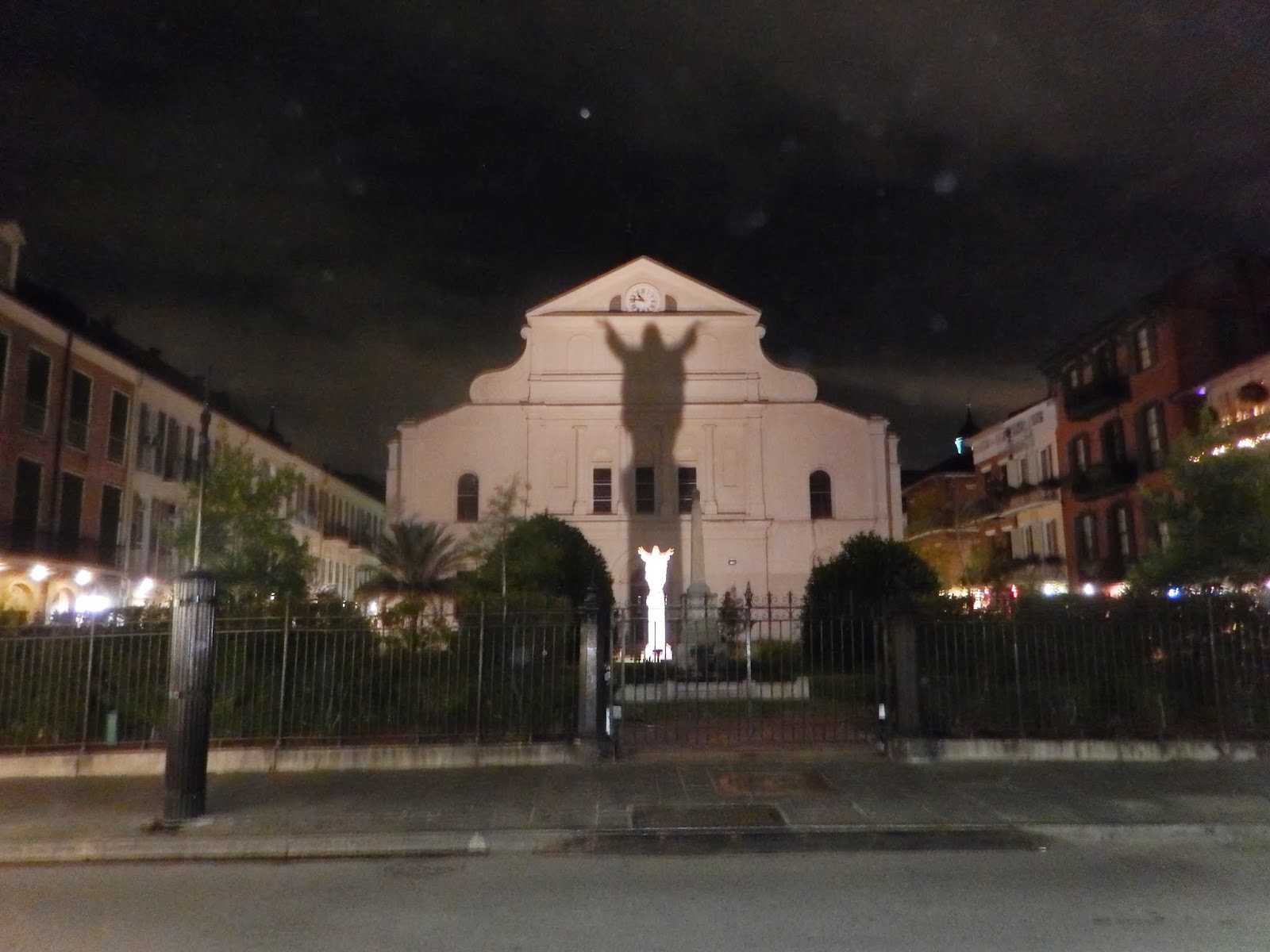
We went to News Orleans this past week.  It was the third time I'd been there, and this time the charm came through, not in a touristy, gaudy way, but in a sort of febrile, smelly, yet still delicately poetic manner.  The smells on all the streets in the French Quarter (and even beyond)  had a definite rotten taint but they also held a beautiful dank perfume, a promise that death becomes something else once you get past the stink, past what it is.  It was Blanche's thoughts I was smelling somehow, as if everything she'd ever said or imagined had gone olfactory, a New Orleans poetry of pheromones. 

Time somehow went to sleep in New Orleans this visit for me. 

Tennessee references that in the little quote above as well.  It actually did feel like time was turning into something other than measurement as we ate and drank ourselves into a sort of miniature oblivion, walking all over the city.  One afternoon, when it was pouring rain, and everything was hazy and gloomy, we went to the movies to get out of the mess.  We saw Gravity in 3D, in which a lady astronaut played by Sandra Bullock is in peril, floating above the earth, trying to find passage home.  It was so serendipitous as to be hypnotic, and a symbol of the whole trip. Watching Gravity covered in New Orleans rain, I saw Vivien Leigh's Blanche in my head, a sort of split-screen:  Sandra Bullock trapped in outer-space in computer-generated grandeur and Vivien Leigh trapped inside a cramped, sad tenement in Elysian Fields in glamorous black and white...  I don't know.  The whole visit was like that, disjointed, meaningful, but I didn't really know what to do with the meaning other than simply live with it, enjoy it in a way that goes beyond "enjoying" something. 

New Orleans truly is a work of art.  It has a way of escaping what it is by being exactly what it is.

(Thanks to Terri for making it happen.  And to Bill for taking some pictures.)


Sunday, November 3, 2013

You're So Thoughtful


A couple weeks back I got invited to give a talk to a group of social-work students at Indiana University/Purdue University in Indianapolis (IUPUI).  A friend of mine is in the MSW program there, and she asked her professor to invite me to speak about what I've done in my line of work as a sort of social-worker (I'm not a licensed anything, but I guess what I do both as a vocation and a practice beyond vocation could be characterized as "social-work.").  I also got my undergrad degree there in English back in 1991.  It was totally weird to walk the space-age hallways at IUPUI again.  The whole campus has the feel of a 1970s futuristic movie like Logan's Run.   I took along a Powerpoint Bill and I put together that commemorates the 10th anniversary of Visionaries + Voices (we started V+V in 2003), as well as the beginning of Thunder-Sky, Inc. in 2009.  The pictures are self-evident:  the reason I do what I do arts-wise is because of the people I met back in the late 90s and early 2000s, mainly artists like Raymond Thunder-Sky, Antonio Adams, Paul Rowland, and several others that were in photos from little gigs we did back in 2000, 2001, 2002, art-shows in public libraries and in coffee-shops and anywhere else that would have us, finally ending up with a studio in Essex Studios in Walnut Hills.  The V+V journey Bill and I took that started in 2003 and kind of ended in 2009 was totally a joy but also filled with little pockets of terror, frustration and shock.  I know that sounds melodramatic, but it's embarrassingly true.  We really dedicated our lives to it there for a while, to the point we couldn't pull who we were away from what it was, and more importantly what it was becoming.  I bet that happens to a lot with "founders" of anything.  We just kept at it so hard and so fervently that somehow it became a nightmare toward the end:  lots of creepy meetings and off-kilter emails and finally the feeling that everything we tried to do was kind of lost in the non-profit-professional shuffle. 
 
You can't really say that stuff to a roomful of MSW students, so of course I kept the whole thing inspirational (and truly many aspects of the V+V Experience were), but I kind of let them know that the main thing I learned from helping to start and sustain a non-profit organization for "artists with disabilities" was that you have to figure out the limits of believing in something before, during and after you start doing something about it.  If you don't understand those limits you start confusing yourself and others with your own heart-felt bullshit.  You can lose yourself in the "vision and mission" as it concretizes into something people can be paid for. 
 
You almost have to have a secret, strict resolve to remove yourself from "growth" and "outcomes" and "friend-raising."  I never went into the whole thing thinking it was about helping people with disabilities, to be honest.  I never considered the endeavor "social-work" or even charity.  I always saw all the people we were working with as peers and partners not in need of a lot of help outside of art supplies and opportunities to show and be seen.  I never thought the whole endeavor would morph into HR or Executive Committees or Elevator Speeches, even while I worked very hard to make those things happen.    
 
Anyway, during the little talk I gave, as I clicked from slide to slide, and year to year, I got a feeling that it was worth it in the end.  Because it has to be.  And Bill and I did Thunder-Sky, Inc. in 2009 to kind of recover what we felt we lost:  a simplicity of message, a graceful allegiance to one small idea.  I guess the main idea we're after is that art has a reason to exist in everybody's lives, and that the whole point for organizing around that idea is to have total equality from the get go.  Unfortunately when you organize things conventionally, order and control kind of take over (it's a people business after all), and you lose things, including your purpose.  And after awhile I didn't want to lose things anymore. 
 
Thunder-Sky, Inc. has always been about not losing things:  keeping Raymond's drawings safe, all the other stuff he left behind too, but also that initial idea of art helping us all transcend what we do to each other not getting coopted and redefined as a new tagline or mission statement.  I couldn't explain to the social-work students that I've always wanted Thunder-Sky, Inc. to be a DISorganization, a place without a lot of structure or meetings or committees.  A place where things don't get lost, but they don't get found either.
 
Four years into Thunder-Sky, Inc., it feels kind of like we're floating into and out of what it means to be established.  And I think that's the way Raymond would work it too.  Constantly out of the periphery, wryly smiling, walking through the world kind of bemused and kind of pissed, making art without much fuss, and finding a way to live without losing what it means to be alive.
 
Last night we hosted a poetry and fiction reading.  It was a packed house, and the two writers, Lisa Ampleman and Tessa Mellas, were great, reading Courtney Love poems and a short story about an alien from Jupiter taking advantage of Affirmative Action.  The words combined with the art on the walls, and it was a trippy little session.  It made me feel like we know what we're doing sometimes, and it doesn't have anything to do with anything, except that it's a moment in time when people get together and stop the crap long enough to appreciate each other.  I love this photo from last night.  It sums up a lot of things: