Showing posts with label Jean Dubuffet. Show all posts

Sunday, May 3, 2015

"Let's Talk about Disobeying"


Let's start with Jean Dubuffet, the guy who kind of started it all (at least in my head):  "Art does not lie down on the bed that is made for it; it runs away as soon as one says its name; it loves to go incognito. Its best moments are when it forgets what it is called."
 
Amnesia is a good thing in a universe always starved for commemoration, status, brand.  The "universe" I'm getting ready to jabber about is "art" in all of its manifestations:  small-town, big-town, art-school, self-taught, blah and blah and blah. 
 
Everything has to have a name on it, not just a title or the media or the dimensions, but a name:  who did it usurps the purpose of its construction and eventual adoration.  When you take away all of that demarcation and you just look at something for what it is, what the hell happens?  I don't know.  Maybe you just see it.  And that's the most complicated process known to man or woman or whatever.  "Seeing something" without extrapolation, untethered by biography, connections, credentialization, format, institution, organization...  Just looking at the thing and going off on it, "finding" it inside yourself, unspooling from its atmosphere into yours.  All of that is what I want to happen when I go to art-shows.  That's why I hate opening receptions for the most part, because the social aspect disrupts the poetic.  I know that sounds grumpy, but that's the deal, and nobody really cares anyway, but still -- looking is an art too.  "Purity" means something in that moment, and that's why the white clean box of a gallery exists (outside of commodities, sales, branding, etc. of course).  That blankness and clarity outlines the thing(s) being exhibited, and gives you that simple moment of serendipity you live for, that connection beyond connections, when you and it have a little party, all those associations you've bottled up pouring out, landing, pooling, and then it's over.  Sounds like sex, I know, but it's not.  It's not even a version of sex.  Sex is all the other stuff.  This is prayer, and I know segregating prayer from sex is probably old-fashioned, maybe even stilted and officious, but they are completely different, just like seeing and pretending to see are.
 
So here's the deal:  breaking art away from art, looking at something and understanding it's only yours, not even the property of the one who made it.  That's love.  That's what I want to feel when I go to a gallery or museum, like I've stumbled outside of myself and all other selves, and it's the time between memory and ego, the space between love and saying "I love you." 
 
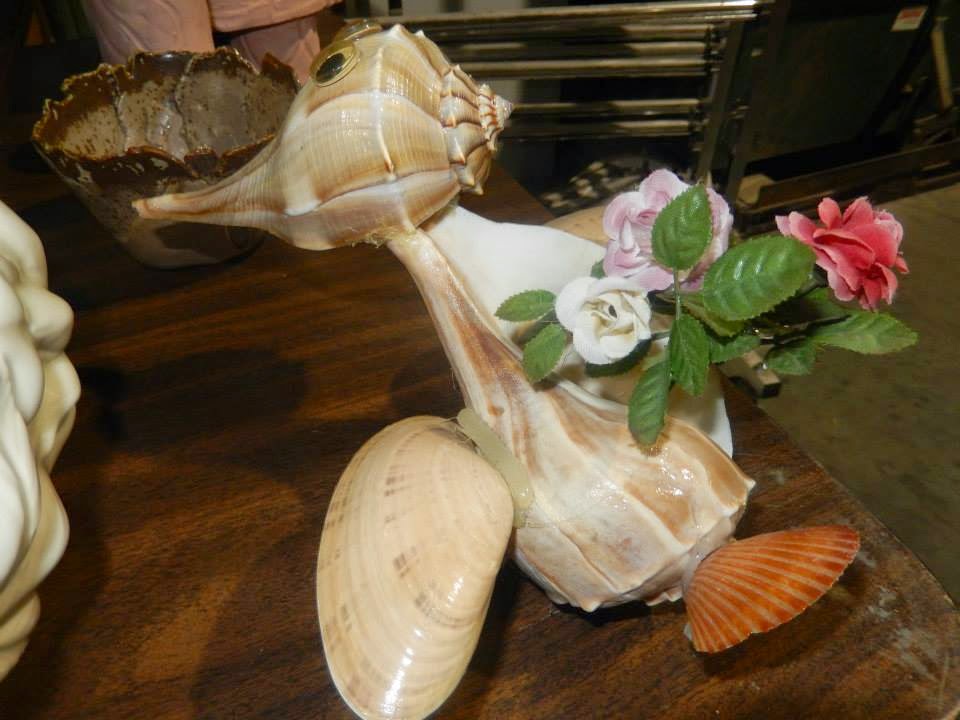
Up top are photos of anonymous art made by people we don't know and given away to Goodwill as donations. 
 
Dumpster diving for tossed-aside artworks is not a new procedure by any means.  There are whole galleries and even a museum or two that specialize in this activity, and more power to them.  Love the idea obviously.  I wanted to do a Goodwill show at Thunder-Sky, Inc. under the umbrella of not giving a shit about identity, about separating art from the ever encroaching and totally minuscule idea that "art is a career."  Maybe it is, maybe it isn't.  But gazing at stuff that has been dislocated from any conscious effort to be claimed as "art" is truly about finding value and worth in life and lives outside of the ongoing diorama of careers and namedropping and scholarly endeavors and art-fairs and so on.  Without that apparatus what does art mean? 
 
I'm totally interested in this because the way I entered the art-world (and continue to stumble through it) is through non-profit little "alternative" spaces where artists often got together to show work without a connection to prestige or fortune:  white-boxes as experimental spaceships, filled with oddness and fever, not built to please, just built to take off and go three or four inches forward.  And when I decided to make art a parallel activity to supporting people with developmental disabilities, "outsider art" became that spaceship, but then again it also became a big black hole. 
 
Identity for "outsider artists" is pretty random and ransacked, based on the market controlled by buyers with good intentions, but also on a concept that artists who are labeled "outsiders" don't have careers, don't have ambition, and that makes them "precious" and "pure."  Still, however, there's those market forces, and in that market the more "precious" and "pure" the artist is (or the artist is seen to be), the more value accrues.  "Outsider artists" shouldn't talk; they should just make cool weird stuff in little romantic hovels, preferably in a sepia-toned, cobwebby Europe in the 1930s or 40s.  That gloss, that sense of majestic "outsiderness," wipes out any sense of equality and inclusion involved.  There are the actual artists with careers and the "outsider" ones who do stuff without thinking about any of that stuff. 
 
And within the context of that pretty reliable binary in steps the sensibility that no one's biography and credentials fucking matter.  How about that?
 
Walls and pedestals displaying art donated to the Goodwill seem like the best next step in trying to unravel all that distinction, all that pomp.
 
While we curate the show (titled "The Goodwill Biennial" debuting in late August), I'll be thinking about all of this, and examining all the exposed ambition and thought and dream involved in the production of art that does not make it, an art disassociated and almost formless, paintings and sculptures and drawings and whatever else populating that universe of amnesia, set aside and bleak, but also waiting to be discovered for exactly what it is.          
 
One of my best experiences in dealing with all of these thoughts in an art-world context came early last year, when we went to New York City to see the retrospective at PS 1 of Mike Kelley's life and work.  Kelley killed himself in 2012, so he made himself kind of gone from the equation from the get-go, and yet suicide probably has made his prices go up, right?  He was famous for being reticent and DIY-difficult, but also for being a totally prolific genius.  His works, resplendent with a Goodwill-harbored sense of the tossed-aside (dirty stuffed animals are one of his main contributions to artistic culture), spoke volumes to me about the desire to escape authorship and bull-shit.  PS 1 was overwrought with Kelley work, sculptures, performances on video, films, drawings, ephemeral collections, a whole suite dedicated to building miniature versions of comic-book kingdoms, all of that stuff and thought presented not as biography exactly, but as production, as manifestations of the obsession to make something, anything, that allows you to escape what you think is going to happen, even if it does (did).
 
Mike Kelley:  "I chose art, not to become successful, because you couldn’t make a living from being an artist at that time. It was a profession I chose specifically in order to be a failure."
 
That "failure" I guess is what I'm talking about.  I think Kelley used "failure" as a synonym for "disappearance," that beautiful state of elevated nothingness that allows everyone to actually see the universe without being in it.  "Failure" as a synonym for "art."
 
"The Goodwill Biennial" opens August 28, 2015, reception 6 to 10 pm at Thunder-Sky, Inc. 
 
Mike Kelley banner in the PS 1 2014 show in NYC.
 

Wednesday, February 1, 2012

Monsters of the World

Andrew Cole

Andrew Cole

Andrew Cole

Dean Millien

Dean Millien

Dean  Millien

I went to the 20th Anniversary Outsider Art Fair last weekend in NYC with friends, and it was a lovely, cleaned-up, curated carnival of an experience.  It was a lot like going to the Folkfest in Atlanta without the folk-artsy "Southern Charm" booths and wares.  All the booths exemplified what "the field" of outsider art has become:  examples of works from programs for artists with disabilities intermingled with "high-end" galleries representing mid-level and higher-level outsider artists.  Lots of gorgeously meandering drawings, flashy expressive paintings, home-made dolls, found-object sculptures.  Etc.

I kept hearing the refrain from the Talking Heads song in my head as I walked through:  "Same as it ever was."  The newness of "outsiderness" has completely worn off, at least for me.  Now everything about the concept has the gleam and gloss of "establishment," an enterprise that has settled into itself and has become what it is supposed to be, and what it will be from now on.  
 
I wasn't bored or outraged by this epiphany.  The experience was completely pleasurable.  I appreciated what the fair was.  I enjoyed the works.  But I also felt my interest slipping away from the concept as a whole.  Putting all these works together under the rubric of "outsider" seems kind of old-hat and a little ersatz now.  Antiquated in a way that can't be addressed through an essay or a symposium. 

In the program that accompanied the fair, Critic Edward M. Gomez writes:  "As many of these outsider art admirers regularly point out, there is one inescapable aspect of the most compelling work made by self-taught artists that never fails to seize their imagination.  That is that it is always profoundly, unmistakably, inexplicably moving."  He goes on to paraphrase Jean Dubuffet, the Godfather of all of this stuff:  "Dubuffet insightfully noted that each of these art-makers produced his or her work primarily for himself or herself, not for a broad public and certainly not for the art market or to grab media attention."

Gomez never really gets at the central irony of all this:  celebrating "outsiderness" by celebrating the way it has become celebrated and commodified, when in effect the whole idea was to shield the concept from this inevitable process.  Or at least complicate it some. 

We stayed with our friends Andrew Cole and Cathy Dailey in Princeton, NJ and took the train in to see the fair.  Andrew and Cathy are really incredible people.  Cathy is a self-taught artist in her own right, and Andrew is a professor at Princeton.  One night Andrew showed us some drawings from his childhood that his mom had saved for him.  They are incredibly silly and potent renderings of reptiles and outerspace creatures and superheroes, all done on notebook paper and stashed inside a green three-ring binder labeled, "Monsters of the World." 

These drawings, to me, were just as exciting as a lot of the stuff I saw at the Outsider Art Fair.  I loved their delicate nostalgic obsessiveness.  Their sweetness.  Knowing Andrew for 20 years also helped.  Something about the intermingling of that self-taught creepiness and knowing the artist in a specific way somehow helps to separate the art you like from the Art World you don't, which is the central problem I think I'm trying to get at.  When outsider art becomes a part of the everyday world, the intimacy becomes commodified.  The stories behind its making evaporate into aphorisms and appraisals.  But those childhood drawings of Andrew's have an authenticity and a preciosuness I can champion without feeling like a douche-bag art critic; they are fun to look at and were produced because of a need to sanctify the delirious love of dinosaurs and lazer beams. Period.  My pleasure at their creation is fortified by the fact that these works were made not to be seen but to be collected in a three-ring binder dream-bible hidden under a little kid's bed.

That same sort of sanctification happens in Dean Millian's work above.  He makes animal sculptures out of aluminum foil, and his work (supported by LAND Gallery, a program for artists with developmental disabilities in Brooklyn) was the best stuff I witnessed at the 20th Anniversary Outsider Art Fair.  I don't know Dean, but I somehow felt the same nostalgic and obsessive sweetness coming from his work as I did from Andrew's:  a sense of play, and a sense of devotion to playing.  But, unlike Andrew's childhood drawings, there is a posh finesse to Dean's work.  He takes the simplest of materials and fashions them into a sophisticated silver menagerie.  It's like merging those high-end aluminum foil swans fancy restaurants give you as doggie-bags with the mythology and grace of Noah's Ark.    

Andrew is a Princeton University Professor.  Dean is an artist labeled with a disability.  But looking at their works I felt the same drive to make something out of nothing.  They both create art that has left its artifice and became blatantly something else, while also maintaining a certain stubbornly authentic aesthetic.  Purity is no longer an issue now that outsider art is what it is.  But purity and an intensity that "is always profoundly, unmistakably, inexplicably moving" comprise outsider art's essence, the reason it exists as a genre.  Placing Andrew and Dean's works side by side complicates "outsiderness" to the point it does not really make sense anymore, and yet maintains the idea that art set free from having to be art always somehow finds a way to exist with or without a fair or a genre or even an audience.

How do you celebrate that?


Saturday, January 8, 2011

"Vonnegut's Ballerinas: Deprogramming 'Outsider Art'"

Raymond Thunder-Sky

Here's a link to a paper I've written for a conference about "outsider art" and its meanings:  "Vonnegut's Ballerinas".  Below is a synopsis of the piece...

Rosemary Garland Thomson writes in her landmark essay “Seeing the Disabled: Visual Rhetorics of Disability in Popular Photography” about the way “non-disabled” people view images of people with disabilities. Thomson's “wondrous” rhetoric especially reads like a dictionary definition not only of the way people with developmental disabilities are codified and colonized by cultural norms, but also the way art made by “outsiders artists” labeled with developmental disabilities is often marketed and explained. The “wondrous rhetoric,” Thomson explains, is the oldest mode of representing disability. This classification includes “monsters and prodigies.”


“Outsider artists,” especially those labeled with developmental disabilities, often have to take a seat at the kid's table culturally speaking, with the caveat being they are “wondrous” but not quite sophisticated enough to have a seat at the “adult table.” In my paper, I use Thomson‟s “wondrous” concept, as well as a reading of Kurt Vonnegut‟s short story “Harrison Bergeron” and a brief survey of the histories of “outsider art” and people with developmental disabilities to critique the manner in which “outsider artists'" lives and art are “programmed” around anachronistic concepts of segregation and “wondrousness,” all based on concepts of “outsider art” that seem to ignore the social and historical colonization people with developmental disabilities have gone through.


I also tell my own personal story in helping to develop an arts program for "outsider artists" with developmental disabilities in Ohio, based on meeting an artist named Raymond Thunder-Sky through my job as a social worker. My initial vision in doing so was to ensure that Raymond's art would be placed side by side with the art of other artists, no labels required. Instead what happened is that I unintentionally created a trap with my good intentions: a program that segregates artists (like Raymond).


We as curators, writers, collectors, and lovers of art made by unconventional artists have to be in the business of pulling apart the clichés and categorizations that plague how these artists are viewed and relegated so that everyone can have access to art that transcends those notions. Without that help, I'm afraid, we'll be constantly reconstructing those clichés until they become the norms we intend to defeat.

Friday, August 27, 2010

That's the Look, That's the Look, That's the Look of Love


This month in Aeqai, a local Cincinnati online art-criticism journal, Alan D. Pocaro writes about the latest works by Spencer Van der Zee at Malton Gallery: "While possessing no formal education in the medium, stylistically, Van der Zee has absorbed all of the conventions associated with the look of the outsider. The drawings on display include juxtaposed images, scrawling lines, doodles, snippets of text, blobs of color, ethereal narratives, and highly rendered scenes that jostle for attention on the surfaces of the support."

I guess my question is: what exactly is "the look" of "outsider art"? The way Alan D. Pocaro frames it, the look is actually just plain old Wetsern art:

"Juxtaposed images" = Surrealism and its offshoots
"Scrawling lines and doodles" = Cy Twombley
"Snippets of text" = Jenny Holzer
"Blobs of color" = take your pick of the Abstract Expressionists on that one
"Ethereal narratives" = William Blake maybe, or Andy Warhol making movies
"Highly rendered scenes ..." = Keith Haring and all that came after.

Or that whole paragraph could be used as a way to define graphic novels about superheroes who think too much, funky-fresh, overly clever/cute ads in Details magazine, or a really cool one-sheeter advertising the Ramones with special guest Blondie back in the day.

I guess what I am getting at is that by appropriating the "look" of "outsider art," you also collapse its meaning. Which from my point of view is a good thing: it takes away the special preciousness embedded in that super-sweet narrative of the naive and innocent outsider "doodling" his/her way into your heart, or that slightly scary outsider creating "highly rendered scenes" of hell or something because he/she just can't take the real world... The good old narrative Jean Dubuffet more-of-less started in 1948, when he officially established his Art Brut collection, modeled after the art collection of Dr. Prinzhorn, a psychiatrist in Germany. Dubuffet's Art Brut collection showcased works of various media, but what made them "outsider" wasn't the "look" or "materials" as much as the biography: the artists in his collection weren't pros. It was a class thing. Dubuffet loved to talk (and often scream) about the works in his collection as alternatives to the tired artwork of Western culture.

Dubuffet's outrage at Western civilization becomes a "look," right? Just another variant of "style." That's not sad at all really, because Dubuffet's initial instinct, to use the art made by unconventional artists as a metaphor for his anger at this rotten old world was kind of self-centered, even while being revolutionary. His insight opened a lot of doors for unconventional artists, but it also created a hallway they can be lead down and then unceremoniously escorted out of.

Dubuffet's Art Brut became Roger Cardinal's "outsider art," and now it has become a a "look." Hooray. But what also is just as wonderful to think about are artists not trying to capture a look, or create art from looking at art, artists who really don't want to be artists but will put up with the whole idea of being one because they truly have something to say that scratches its way out of them visciously and quietly in rooms and trailers and day programs and bus-stations all over the universe. The "outsider art" narrative collapses under the heaviness of the "aesthetic," and what arrives in its place?

Your guess is as good as mine, but I want to be there to see it.

Above: one of Spencer Van der Zee's great outsider-looking collage/drawings, on display at the Malton Gallery in Hyde Park. Cool stuff. Like Max Ernst and Fritz Lang and Cy Twombley and R. Crumb got together and played Exquisite Corpse one afternoon.