Showing posts with label Bill Ross. Show all posts
Thursday, October 1, 2015
War Babies
(Bill makes a special guest appearance with some serious stuff, beautifully conveyed...)
Looking at this picture, I can't help but think what war babies we were. To anyone else this may not be so easy to see. We were born into a war our dad waged against our mom. By the time this picture was taken the war was nearing it's 25 year. With no real understanding as to why, we of course did our share of internalizing what we saw happening as being our fault some how. At least I know I did.
I have beautiful memories of our mom of course. She was a kind woman. She loved to laugh. There was peace in her silence. She was smart and beautiful, especially in her younger days before we were born. These memories, the sweet ones, come in fragments and to retrieve them, I must reach through the times when I would see her blackeyed, bruised, teeth knocked out, scabs on her scalp from hair being pulled out, pushing a cart in a store with no money or washing clothes in the kitchen sink by hand for us.
No amount of effort could pull her away from her life with him. The reasoning probably too simple to consider a real reason. She was forced to quit her job, not allowed to drive. As isolated as we were, where would she go? Our older brothers and sister would try to get her to listen to reason, offering refuge in their tiny newly wed apartments, only managing to give $5.00 or $10.00 to buy some food...cereal suppers.
Dad only worked when he took a notion. So living without electricity or phone or food was just the way it was. He wasn't a drinker. He didn't take drugs. I only saw him drunk once after a party with a company he worked for from time to time as a welder. He was sickenly sweet. My fear of him just turned to disgust. But when he was in a rage they could last for days and sometimes weeks. When beating on mom was not enough we got our share too. There are of course the shooting rampages he went on from time to time, taking out our pets, our cats and dogs. This happened more than once. This happened more than twice. It happened...gunshots echo through the hills, broken glass, broken plates, coffee on the walls, bury the dead.
Again our older brothers and sister would take us in like war babies for a weekend or a week till things died down. No one could really help.
One night late around 11:00, I remember grabbing up Kathy and running out the front door, barefoot down the gravel road in complete darkness. He had started in on mom. I heard him kicking the the kitchen door towards the back of the house. Glass breaking...that scary yell full of pure stupid fury...I heard him say in a matter of fact voice, "I am going to kill our kids!" We ran and ran down the road across the bridge to a neighbor's house. The police were called. They showed up, but dad had left. Nothing was said. No one talked about it...forget...everything gets buried.
This summer we had a family reunion. It was great to see the family. Mom and dad are both long gone now. We all have our scars, our lonely burdens. We joke, we drink, we laugh and use whatever fragments, like this picture to realize we survived! We have moved on. We use our time together basicaly asking what the hell was that all about?
The world is full of war babies. So, I'm sharing this to recognize a history that still makes me feel weird at times. Plus I just need to say it. And I want to forgive. It's taken a long time, but I am now at a point in my life where I can look at this picture and be OK.
Friday, August 14, 2015
Ghostliness
Monday night, we started with this little ensemble when looking at how to curate "The Goodwill Biennial," the next gig on deck for Thunder-Sky, Inc. It's a parody of contemporary art-survey biennials across the world, using donated paintings, sculptures, whatever given to the Ohio Valley Goodwill here in Cincinnati as the starting point of a jurying process that includes me, Bill Ross, Matt Distel, Merry Hoefle, Melanie Derrick, Emily Brandehoff, and Antonio Adams. Parodying something as pretentious and serious as a "biennial" is kind of a silly prospect of course, close to shooting million-dollar fish in a million-dollar barrel: those who pursue the biennial lifestyle of course don't give a crap, and those who don't give a crap really don't care. But still satirizing something so contrived and so integral to the way serious art business often gets done (or doesn't get done) gives us a chance to worship at the altar of Pure and Gorgeous Serendipity, as well as the sad and blurry cathedral of Musty-Smelling Ghostliness.
That's definitely the vibe when unpacking donated art: that mildew-enflamed fume, that sad sweet grandma-doesn't-live-here-anymore vapor. In fact, those delicate, precise, dreamy watercolors of 1960s suburban homes surrounded in trees and sunshine had to be unpacked from a mysterious blue suitcase filled with old sketches and photos and prints someone had stuffed into it and locked up tight and sent on its merry way. That blue suitcase mustiness was an entrance into memory, kind of like the marmalade on the cracker moment Proust went on and on and on about. Those drawings have such a tenderness, such a nostalgia, and then Matt located the centrifuge of this whole vortex by grabbing the portrait in the center from off the floor, and there she was: Nancy Kincaide, a name we all brainstormed into being. She was a realtor, a murderess, a vindictive socialite and so on. The painting itself is green and heavy and small, and Nancy's countenance both regal and also beautifully come-hither. By juxtaposing the houses with her circumspect portrait Matt intentionally created a tableau that is easily understood but vast with mystery, story after story spilling out of those dark windows, those water-color driveways.
And that's kind of what the whole show is about, dislocating kitsch from all those tossed-aside, handmade objects and finding a way to take seriously what was recently in a canvas bin inside a large warehouse in Woodlawn. Thankfully all the Goodwill staff were game, and thankfully we have some likeminded souls helping us find our way through. But the sentiment is serious, and as we juxtaposed and figured out where things went on Monday night it all became a little emotional, in the way maybe you might feel helping people escape from a prison-camp: there's an odd and kind of exhilarating freedom to reconfiguring what destiny has tried to create and sustain. This stuff was supposed to be either thrown away or tagged and put on a shelf, and here we were thinking about it, playing with it, introducing ourselves to it in a way that wasn't about anything other than making some kind of moment, or series of moments, happen. That's the ecstasy of pure aesthetics right there, taking what's trashed and forgotten and un-trashing it and remembering it in such a way that poetry and a little bliss coalesce, appear and then disappear.
Nancy Kincaide wholeheartedly agrees. Just ask her.
Sunday, March 15, 2015
Storybook
"Now Here: Theoretical Landscapes" is a show currently up at the Carnegie in Covington, Kentucky, curated by Matt Distel. It opened on Friday, and I'm telling you what, it was a blast, lots of people, lots of art... Just great. Matt pulled together such a disparate collection of works that it's hard to figure out what makes the show so fantastic, outside of the fact that the inclusiveness inherent in the curatorial decisions expands ideas instead of claiming them. "Theoretical" and "landscapes" are both loaded little terms that could have backfired pretty easily. They evoke a starchiness somehow, a staid attention to what "art" is supposed to be, and yet every choice Matt makes in "Now Here" overturns that sense of preciousness. It's a 6- or 7-ring circus, this show, and in a totally good way. (One of the highlights, of course from my POV, is Bill's suite of Alice-inspired works/collaborations with Meddling with Nature's Jeremy Johnson, Sharon Butler and Bob Scheadler, a horrifyingly joyous set-piece comprised of his Technicolor paintings, a dead dryer, dead leaves and dead animals that comes off like a fever-dream/nightmare but also invokes the sad innocence of abandoned amusement parks.)
Matt has created a weirdly cohesive, poetic plurality in "Now Here" by assembling all these artists and all these works made from every media you could think of (including duct-tape, the aforementioned taxidermy, cardboard, and cement, just to name a few, as well as the old oil and acrylic standbys), and when you walk through the whole shebang you feel as if your brain-space is being expanded so that all this cool stuff can get in. Then you remember the topic (landscapes, theory, the now and the here) and you get the joke, while also understanding the serious and beautiful punch-line each piece evokes. It's like Matt is taking you on a hot-air balloon ride over a little subdivision called The Land of Art, effortlessly educational, a little elevated, but totally storybook sweet, even while grounded in exactly what it is.
And speaking of sweet, at least for me, I got to hang out with Kathy Brannigan, one of the artists (along with Krista Gregory and Jamie Muenzer) who were a part of a wall drawing escapade that truly feels magically delicious. Kathy's drawings of airplanes and spaceships anchor the exercise, beautifully smudged graphite depictions that somehow feel both nervous and stately, like doodles done in a boardroom. Glitter and geometric flourishes play back-up singers to these intimate aerospace drawings. Somehow the whole enterprise feels like a microcosm of the rest of the show: astute, wide open, frenetic, but also friendly, aligned, and just plain pretty. Kathy (pictured above next to some of her graphite hieroglyphics) was one of the first artists Bill and I ran across when we started pulling together Visionaries + Voices years back, and she still hangs out there, but Friday night she was a part of a whole new landscape: an astronaut finding a wonderfully temporary home.
Monday, September 30, 2013
Loud Enigma
It's always hard to come up with a postcard invite for a group-show. You don't want to feature one artist, and you want to give a sort of global take on the concept, but a "global take" never is that interesting. So often what gallery people do is collage together a bunch of images, which makes everything look a little puny, even while you're desperately trying not to. So for our upcoming show, "Superunknown: the Neo-Folk Impulse," curated by Leigh Cooney and featuring Andrea Heimer, The Cooney Brothers, Mike Egan, Ben Kehoe, Bill Ross, Marc Lambert, and Matthew Waldeck, I thought a little bit and decided: go with Raymond. But not a Raymond drawing, a Raymond costume. "Superunknown" could totally describe Raymond during his heyday. He was a secret, unnerving, but beautiful presence on Cincinnati streets, walking in one of those clown outfits with a big ominous toolbox in tow. He created his own enigma, and boy was it loud. A "loud enigma" is kind of a good way of explaining what Leigh is after in the show: folk art that does not have a sense of preciousness, but a smart snappy attitude that deconstructs notions of what "folk/outsider/self-taught" art can mean and be. He's selected these artists because they seem to be working on art that does not conform to notions that are already in the world. They are mining what's inside their minds and souls without aligning themselves with a genre or school.
So be on the lookout for the "Superunknown" postcard. Coming soon...
Saturday, September 14, 2013
We Don't Know What Else to Do
Toronto-based artist Leigh Cooney is curating Superunknown: The Neo-Folk Impulse, featuring new works by The Cooney Brothers, Mike Egan, Andrea Heimer, Ben Kehoe, Marc Lambert, Bill Ross, and Matthew Waldeck. This show that ends Thunder-Sky, Inc. 2013 season with a bang. Here's a wonderful, insightful essay Leigh wrote to accompany the show. We'll also be publishing a catalog in which this will appear.
I must begin by saying that I have a very limited knowledge of art history, contemporary practices, or terminology. I did not go to art college. In fact I only failed one course in high school and it was visual arts which was a requirement for art college. This led me to give up on art for several years. I own, yet have never read, an entire book on art history. (Yeah okay I like the pictures.) I do not claim to be an expert on the definitions of “outsider” “folk,” and/or “visionary art.” I’m ignorant of what makes a piece of art “great,” and yet I do not live in a cave, (or for that matter a psychiatric facility). I would never say I am completely removed from the art world. And yes, because of my ADHD I can only write in a stream of consciousness format so you’re going to see a lot of parenthesis where thoughts are broken up by thoughts as well as run on sentences and phrases that are sometimes deliberate (for emphasis) and sometimes not. Deal with it.
However having said that, I don’t believe my ignorance gives me any less authority to speak on art within the parameters of these limitations. Why? Well as an art authority answer me this: I have no doubt that the great Henry Darger’s knowledge of the art world was extremely limited; however I think it would be inappropriate to assume he was completely unaware of at least some of the more famous works. If you could bring Darger (one of his works above) back and ask his opinion on art within these parameters would you want to hear what he has to say? Would you want him to explain his own work? Would you like him to reflect on art in general in relation to his work? Of course you would. Would you ridicule him or dismiss him because he didn’t have the right terminology or knowledge? Absolutely not, because unless you want to be the laughing stock of both the above and underground art worlds you have to recognize Darger’s genius... because those are the rules, and art world people like to follow the art world rules.
You would want to hear him out because he is an artist, and an artist doesn’t need to study the books, although it can be an advantage depending on what you would like to accomplish. An artist simply needs to create viscerally and instinctually, and in doing so a self-taught artist will more than likely come to many of the same results as a classically trained artist in the end but will come to these conclusions organically and generally at a significantly slower pace. It is often inevitable during this process for an artist to create her own opinions and connections and sometimes she needs to trust herself in spite of feeling overwhelmed when faced with so-called “expert” opinions. This is after all art not science and there is room for subjectivity and opinion even from the lowliest and most “ignorant” of us.
So how did I, a mere self-taught artist come to curate Superunknown? Well firstly it must be said that much of the credit goes to Bill and Keith at Thunder-Sky, Inc. who are immersed in self-taught art daily and have no pretensions (that I can see) about who can have an opinion on art. It is galleries like Thundersky that give artists like myself who exist on the fringes of the art world the confidence to state their opinion and to state that they have an opinion at all!
To fully understand my own interest in folk and outsider art we must go back four years to when I first picked up a paintbrush (outside of those doomed high school classes 7 years before) and decided I would create for the sake of creating with absolutely no expectations as to the results. Up until that point I was very limited in terms of what I considered great art. I could only fully appreciate art that showed a very high level of “craftsmanship” like Michelangelo, Salvador Dali, Mark Ryden, and Chuck Close. I hated so-called “modern” or “abstract” work. (Here’s where my terminology shows its limitations… I’m pretty sure “abstract” as an all-embracing term is frowned upon, but I’m not sure what would be better suited?) It was for this reason that I threw out my paintbrushes after high school upon realizing I couldn’t go to college. If I couldn’t go to college and learn to paint like a master, I didn’t want to paint at all. Oh youthful ignorance… but of course things eventually came around.
When I began I was inspired by two artists specifically. One was the late New Yorker Jean Michel Basquiat, and a little later came my introduction to Outsider artist Gerald “X” Thornton (Basquiat on top; Thornton bottom). I did not immediately warm to either of these artists, I had the usual misguided “my kid could paint that attitude” to both. But again and again I came back to Basquiat, and one day something clicked. I felt that here were artists who sat down in front of a canvas and (arguably in Basquiat’s case) weren’t for a second worried about image or perception or an audience. They painted purely to communicate and the sense of naiveté that I perceived seemed to me to reflect a certain raw edge in their very souls that screamed self-doubt and desperation, and that was something I understood. And when I realized I empathized with these artists it occurred to me that I was appreciating their work less for the sugary finish that I found in a Dali or a Ryden, and more for the underlying narrative they seemed to be struggling to convey as well their own inner struggle itself. I was hooked.
I wanted to paint fast and without hesitation. I went out later and bought the cheapest brushes, canvases, and paint I could find (I still work with the same materials) and I sat down one afternoon and promised myself that I would start and finish a painting that afternoon. I did and the result was a mediocre attempt at best but the fact that I had not stopped to reflect self-consciously during the process meant more to me than the finished work. That year I would create hundreds of new paintings and I would continue to discover Outsider artists I admired. I wasn’t overly interested in the history (psychological or otherwise) of the artists I discovered and I was even less interested in the squabbling over definitions that I soon discovered was such an integral part of the world of Outsider art; I was simply interested in their subject matter and the way in which they presented it. During this first year of painting I found I could connect with groups via the internet that appreciated Self-taught art as much as I did. This was wonderful as I was too far removed from the art world both psychologically as well as geographically to be able to connect in person.
The style, subject matter, and association with Outsider fans led me to be grouped into the Outsider label myself and I was more than happy with that. It wasn’t long however before I inevitably discovered the sensitivity of certain critics to the connotations inherent in the term “Outsider.” This squabbling as well as the fact that my work was inadvertently becoming more streamlined and less “naïve” in appearance led me to distance myself from the outsider label. It only seemed fair, and I learned fairly quickly that if you wanted to call yourself a self-taught artist you better “appear to be self-taught…” in other words you couldn’t allow your work to become more technically proficient. As my work became more proficient and less naive in appearance I began to start my own questioning of terms like “Outsider,” “Art Brut,” “Self-Taught,” “Visionary,” and so on. I began to become more interested in that blurred line that disconnects the aboveground art world, and the underground art world of which I was a part, and finally the subterranean Outsider world that I was overlapping with. Not because I wanted to attempt a grouping of myself into any of these, but because I started to think maybe art labels in general were arbitrary and often misleading and best left to people who are more interested in marketing and labeling than the art itself.
This leads me to why I decided to curate a show of artists that each exemplify some facet of my love of Folk and Outsider art, yet would not be considered “Outsider” artists by the restrictive traditional definitions. These are artists that exist in neither the mainstream art world nor the Outsider art world. Some of these artists are self-taught, some are classically trained, some have a body of work that is more naieve in appearance, and some have a look that is more classical in appearance, but all have some aspect to their work that I feel falls into both the categories of contemporary pop art, and folk art. I originally thought I’d call the show Pop-Folk but I settled on Neo-Folk as a nod to my British friend and art theorist Dr. Melissa Westbrook who coined the term Neo-Outsider to group together many of these same artists that exist on the fringes of the underground, aboveground, and Outsider art worlds.
Why these artists?
After I considered the attitudes of the potential artists and dismissed a couple I respected but didn’t like on a personal level, I considered the art itself. As I mentioned before each artist has some quality to their work either physically or spiritually that borrows, pays homage, or otherwise embodies in a natural way (with little forethought or deliberation) the work of Outsider and especially folk artists. To me these artists felt pure and unpretentious in their approach in the way that the best Outsider artists do. None of these artists appear to be creating art with the sole purpose of selling work in the way that the best Outsider artists do. Although the works of these artists vary widely in presentation, they each seem to be trying to express a frustration with, and discomfort inherent in living on the fringes of the fast-paced and impersonal modern world that none feel quite at home in… you got it, the way the best Outsider artists do.
I love the natural way that these artists present themselves. Too many artists are wrapped up in the potential viewer’s perception of their art and they begin unconsciously to create art that aims to please others rather than themselves and this often results in work that is very fine at a glance, but like white bread lacks that nutritional punch that keeps you going. But like brain candy for the intellectual sweet tooth, the works in this show contain the best of both worlds, they are fun and tasty at a glance, but they have substance and keep you coming back for more.
With Ben (pictured above) I appreciated his use of autumn weather, the outdoors, grassy knowles, farm animals, wild beasts, spirituality and scenes played out against that backdrop which I often associate with folky Southern U.S. art traditions, and which I thought invoked the spirit of those that came before him that were dismissed as mere “folk artists” because they weren’t painting what those collectors and critics in the big North-Eastern U.S cities thought was in vogue at the time and were looking to buy into.
I felt the same way about Mike’s work (above), even though Mike was presenting himself in such a different way. His work invoked not only the spirit of the Southern U.S. folky (as well as folk artists from South America and Mexico,) but also the minimalist style of these artists. Much like the artists that existed long before there was such thing as an “art world” or even the word “artist” for that matter Mike’s work spoke to me of birth, death, rebirth, religion, and what is often referred to as the human spirit.
Most importantly, both Mike and Ben (who grew up together and remain friends to this day) took these Southern U.S traditions and blended them with just a hint of contemporary “Lowbrow” and Pop-Art sensibilities. And therein lays the definition of Pop-Folk or Neo-Folk. But again I don’t suggest these titles to limit or otherwise narrow the viewer’s interpretation of the work, but rather to guide the questions a visitor to this exhibit might ask so that we can reinterpret our narrow view of what it means to associated with the self-taught traditions.
My brother Roland (or rolo as he’s known,) and Andrea Heimer (rolo's work pictured on top; Andrea's under) display the naïve (or in this case “faux-naïve” characteristics that remind me of the purity of the greatest of Outsider “self-taught” artists. I love that the uninitiated might look at the work of these two artists and dismiss it out of hand simply because it doesn’t attempt to impress with flourishes of so-called “craftsmanship.” One need only stop and read the titles associated with each painting to see that there is so much more on display here than crudely rendered narrative illustration work (and I mean that in the best possible way because I am a huge admirer of this style and these two artists.) These paintings more than any of the others offer up the confessions of the artists themselves, and reveal their discomfort with the tension that bubbles just beneath the surface of contemporary suburban living. Andrea often fills her pictures with symbolism and stories where rolo strips his work of most of the available signals as to his intent leaving just the bare bones, but both question what results from our neighbours bottling up their emotions and desires, and how it feels to both belong to as well as be scraped, grinded, pushed, and shredded on the cheese grater of modern life. Rolo and I would like to take this opportunity to coin the phrase “The Norman Rockwell of the Suburban Underbelly" to describe Andrea Heimer.
As anyone who is familiar with Thunder-Sky, Inc. knows, Bill Ross is both the co-founder of the gallery and an artist in his own right. Bill’s work is the most pop influenced of all the artists involved in this show and I believe he really puts the Neo in Neo-Folk, but if we are really going to knock around arbitrary titles here I feel Bill’s work would fit right into a Los Angeles contemporary gallery with today’s top “Pop-Surrealists” or “Lowbrow” painters simply due to the fact that (more so than many of the PS and LB artists in today’s magazines) he actually embodies the definition of PS and LB art by being down right funny, pop influenced, colorful, kitschy, and confessional all at once. Bill’s paintings have the natural dark humour of someone who has seen how differently people can be treated either in his own experiences or through the lives of those he has come into contact with during his years as a social worker for people with disabilities.
It was Bill and Keith at Thunder-Sky, Inc. that introduced me to the paintings of Marc Lambert and the sculpture of Matt Waldeck (above, with Marc's on top, Matt's beneath) and I was immediately impressed. We agreed these Cincinnatti artists would be a great fit, but I think I’ll leave it up to Bill or Keith to better explain in their own words what it was about Marc and Matt that sparked his interest in their work. Keith here: Marc's sci-fi exuberance, and Matt's intricate, sweetly steam-punk daydreams so fit with Leigh's overall thesis: they take pop-culture and channel it through a very self-made network of "not knowing what else to do," thus merging kitsch with seriousness, fanboy-ness with technique and style that supersedes pretentiousness while paying homage to invention.
As for myself, I see some obvious and not-so-obvious but still very real parallels between my work and the work of everyone in this show (hence the gathering of these particular artists.) Some of this is due to the fact that I am influenced by every one of the artists daily, and some of it is due to the fact that I believe I draw from the same creative well as each of these individuals. I don’t have to speculate as to my influences or the signals and symbolism in my paintings because I know exactly what drives me. I like naieve and faux naieve work more than any contemporary art style, I am hugely influenced by the physical stiffness of the characters found in Outsider and medieval art, I am fascinated by the desires we hide away and the masks we wear during the day and hang from our bed posts at night. I like Kitsch and bright colours. I like pop culture, pop art, and pop music. I like to express and confess. I want to be part of the popular clique at the school of life, while I simultaneously despise them for putting me so firmly outside the circle.
I suffer from anxiety and I fear most of the artists in this show do as well, and most of my work involves the struggles we face with anxiety and in my case the overlapping ADHD problem. My work also asks questions that are related involving what I perceive as the absurdities of religion and the difficulties of the day to day interactions with folks that many people take for granted. My work is very confessional but in some cases it is buried so deeply below a layer of stripped down symbolism the intentions thankfully aren’t very clear.
These artists and I are not inside and we are not outside, but we are creating because much like the Outsiders, Folkies, Visionaries, and cast-offs before us we don’t know what else to do.
Thursday, March 31, 2011
Becky Iker + Bill Ross + Ten Years in the Making
This is a fraction of the pieces Becky Iker and Bill Ross have completed in the last ten years. A couple will be featured in "2 + 2 = 5: Collaborations" opening April 29, 2011 at Thunder-Sky, Inc.
Labels:
2 + 2 = 5,
Becky Iker,
Bill Ross,
Raymond Thunder-Sky
Wednesday, March 16, 2011
Alive + Well = Collaboration
Bill Ross and Becky Iker: Over the years Bill and Becky have created close to 50 paintings together. Becky does the drawings and Bill does the painting. Above: one of their pieces...
Collaboration Is alive and well via V&V’s “Double Vision II” and Thunder-Sky Inc’s “2 + 2 = 5”
It is great to see Visionaries & Voices (V&V) continues to embrace and celebrate ‘collaboration” as a way to make art with their one night exhibit and fundraiser called “Double Vision II”. For me, making art is probably the only real form of magic that exists in the world. Artwork that emerges from collaboration can be more powerful than a solo project. In fact, collaborating can change your life.
I know this because in my early art school days, my painting instructor, Sue Johnson, randomly assigned me to collaborate with another art student. That student was Keith Banner. We became great friends and continued to collaborate from that point forward. In fact this May will mark our 21st year together as a couple.
So when it came to developing V&V back in 2002/2003, one of the cornerstones of the enterprise had to be, you guessed it, “COLLABORATION”. Bringing artists together with and without disabilities was a way to move things forward. Shows like “We Come in Peace” and “Same Difference” at Artworks and even “Pop Life” at the former UC Gallery on Sycamore were all vehicles showcasing the power of collaboration. Our training as artists and our jobs as social workers helped us to synthesize into “Culture workers”. Collaborating became a way to see results more quickly.
In those days and still now, collaborating can do a lot of “culture” work. When two artists come together to create regardless of backgrounds or history or issues, perceptions can change. The community can be made richer, more colorful, more, alive. Artists who may otherwise go unnoticed can be more quickly woven into the fabric of a larger conversation, a larger art world. Artists who may feel they are accomplished or established can be challenged or inspired in a new way. New techniques, imagery or ideas can develop, barriers can be eliminated.
What I have grown to appreciate over the years is that collaborating can be extremely difficult, but when it works it is great. A truly brand new piece can emerge that would not be possible without the other artist’s involvement… a new vision, experience or clarity can be derived. It can be exciting stuff. It can be more than the sum of its parts.
At our new gallery "Thunder-Sky Inc” we have not forgotten about the power and importance of collaboration. Stop by any Saturday and you may find a collaborative piece being made. In fact at the end of April running through mid June, Thunder-Sky Inc’s ninth exhibit will feature “2+2=5”. This show includes a number of collaborations, both new and old by such artists as Brian Joiner, DJ Maes, Donald Henry, and even Raymond Thunder-Sky himself. Artists who are no longer with us but are very much alive in the works they left behind or inspired.
Monday, February 28, 2011
Baby Cried the Day the Circus Came to Town
| "New Shrine Circus Fun Amusement Park," Raymond Thunder-Sky, marker on cardstock |
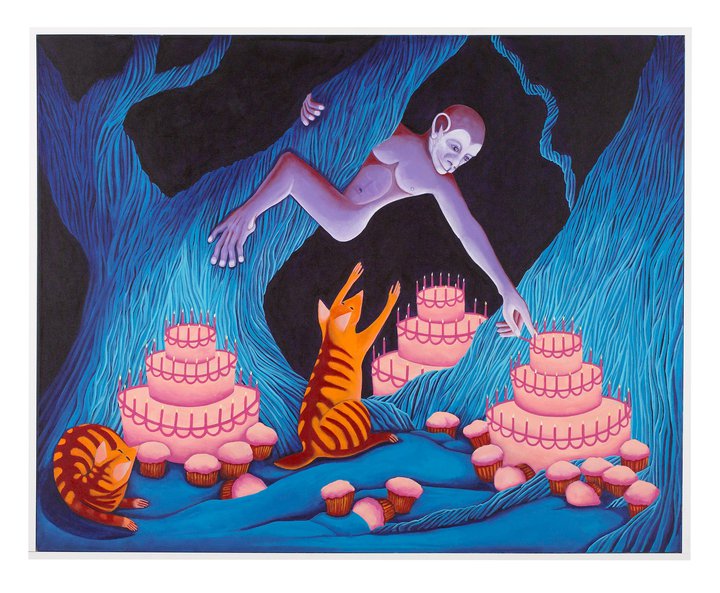
| "I Want to Be the One with the Most Cake," Bill Ross, acrylic on canvas |
![]() |
| "Ringling Bro and Barnum & Bailey" poster |
![]() |
| "Will You Say Good Things About Us?" Eric Ruschman, oil and enamel on MDF panel |
"Baby cried the day the circus came to town," sings Melissa Manchester in that beautifully cheesy late-70s pop song "Don't Cry Out Loud." And that mix of melodrama and spectacle gives the idea of "the circus" a sort of David-Lynch exoticism: surrealism born from innocence and seediness, transient people and caged beasts. There's a couple of exhibitions coming up this month in town that pay homage (one intentionally, one not so) to this strange spectacle and the need to contain it elegantly and painstakingly in visual art.
"It's Dangerous to Go Alone! Take This: New Paintings by Eric Ruschman" opens March 4, 2011 at Aisle Gallery (424 Findley Street 3rd Floor, Cincinnati, Ohio) and surveys the newest works by Ruschman, a Cincinnati-based artist who seems to be on a safari for storybook perfection: shiny surfaces, frighteningly vivid colors, simple, plush imagery. His paintings and other works imply a frozen carnival of the mind, porcelain-precious but also eerily alive. The title of the show, as well, allows for the innocent imagery and the methodical attention to detail to combine into a narrative of leaving for some far-off adventure. Like maybe joining the circus.
"The Amazing American Circus Poster" at the Cincinnati Art Museum spotlights the wit and cagey intelligence behind circus posters created in the late 19th and early 20th Centuries. 80 posters make up the exhibit, and the richness both of imagery and composition comprise a catalog of functional elegance and dreamy nostalgia, like a beautiful scrapbook of hidden Americana. As part of the Art Museum's Family First Saturday program, Thunder-Sky, Inc. co founder Bill Ross will be talking about his colorful, animal-centric works, which are bizarre, twitchy great grandchildren to the straight-forward design and splash of the circus posters. He'll also talk a little about Raymond Thunder-Sky and his work -- and Raymond's deification of all things circus (March 5, 2011, 1 to 4).
Wednesday, February 9, 2011
"Circus-Like Atmosphere: Bill Ross Paintings"
Bill Ross, Thunder-Sky, Inc. co-founder, will be the Visiting Artist at the Cincinnati Art Museum March 5, 2011, 1 to 4 pm. He'll be showing some of his work, as well as Raymond Thunder-Sky's, in context with "The Amazing American Circus Poster," a new exhibit at the museum. Here's a sampling of Bill's circus-like atmosphere:
![]() |
| "The Party Crasher," 4' X 5', acrylic on canvas |
![]() |
| "Be Aware of Your Surroundings," 3' X 4', acrylic on canvas |
| "Boil Water Advisory," 3" X 4', acrylic on canvas |
| "Poem for a Birthday," 4' X 5', acrylic on canvas |
![]() |
| "Mama Bear Syndrome," 3' X 4', acrylic on canvas |
![]() |
| "Mother's Day," 3' X 4', acrylic on canvas |
![]() |
| "Sweet Tooth," 3' X 4', acrylic on canvas |
![]() |
| "Housework," 3' X 4', acrylic on canvas |
Sunday, January 16, 2011
Seance with Art Supplies
We're pulling together the "2 + 2 = 5: Collaborations" exhibit, opening April 29, 2011 at Thunder-Sky, Inc. The show will feature variations on the theme of "collaboration," and how getting rid of "one author" can open up new vistas and territories to investigate. We'll have the "Guernica" pieces Antonio Adams and the late Brian Joiner did together in 2008, a triptych of large golden panels reenacting Picasso's famous grand-guignol masterpiece, re-configuring and re-conjuring that visual feast using superhero and urban imagery. Amazing work. As well, Antonio is working on pieces, utilizing remnants donated from Brian's studio. Pamela Rhodes Myricks has written a beautiful elegy about Brian, and we'll be publishing it along with a brochure about the Antonio/Brian collaborations. We've had large prints made of some of Raymond Thunder-Sky's unfinished works (thanks to Dan Leesman from United Electric), and David Mack, Antonio, and a few other artists are working on "finishing" them. Thunder-Sky, Inc. co-founder Bill Ross has some collabs he did with the late Donald Henry. The exhibit is shaping up to be about how collaboration is not just about people working on art together, but about how collaboration can be a sort of a continuation of a conversation, a seance with art supplies...
We're also going to publish a book of writings inspired by Dale Jackson's text-driven works. Titled I Was Dreaming When I Wrote This, the book will feature color reproductions of Dale's works, side by side with the writings done by local poets and writers, including Patricia Murphy, Matt McBride and Micah Freeman. We'll be sponsoring a reading of these works along with the opening in late April. Matt Morris and Eric Ruschman are also going to contribute a sculptural piece.
| Dale Jackson beside his work in January 2011's "Mechanics of Joy" exhibit at U-Turn Alternative Space in Brighton. |
Can't wait for April!
![]() |
| Donald Henry and Bill Ross, "Dreamhouse," acrylic and marker on canvas, 2009. |
Sunday, November 21, 2010
Break Down
Collaboration breaks down the ego and the mechanics of making art; it supplies a new way to figure out how to invent the wheel. It also allows for biography to be erased, so that eventually only the collaboration, and not the singular artists who created it, become the focus of interest and inspiration.
"2 + 2 = 5: Collaborations" opens the last Friday in April at Thunder-Sky, Inc. If you make collaborative works, contact us about possible inclusion in this show. thunderskyinc@gmail.com.
Above: collaborative work by Becky Iker and Bill Ross...
Labels:
2 + 2 = 5,
Becky Iker,
Bill Ross,
collaborative art,
Thunder-Sky
Tuesday, October 19, 2010
Yet to Be Born
This decade has been a strange experience in loss for me. This Friday 10-22-10 marks the 8th anniversary of my mother’s death. I found out she had cancer in June of 2002. That same day I found out Raymond Thunder-Sky had cancer as well. He passed away 10-29-04. The 6th anniversary of his passing will mark the first year anniversary of the opening of Thunder-Sky Inc.
In January of 2008 I lost my father and in Sept 2009 an artist Keith and I championed, Donald Henry, passed away suddenly. The recent passing of Brian Joiner shook me more than I thought it would. I thought knowing this was likely based on his condition would have lessened the effect.
I ran across a piece I wrote about “Vision and Mission” which I shared with all the staff at Visionaries & Voices on 10-22-08. In it, I tried to address how the death of my Mother and loss of Raymond Thunder-Sky shaped the urgency of what we (Keith and I) were trying to accomplish.
Here is a little bit of it:
I consider art as a great equalizer. When artists collaborate, it is one of the best ways I know of to step outside yourself and become a part of a larger conversation and a larger art world. The “Guernica Project” Antonio Adams and Brian Joiner are currently finishing up is a great example of what I am trying to say. Using one of Picasso’s most famous works as a spring board into a new work, Antonio and Brian are creating a work neither of them would be able to accomplish on their own.
As a co-founder of V&V, I appreciate your struggles and am proud of your accomplishments. It is my hope, my dream, my vision to someday see V&V serving the Raymond Thunder-Sky’s, the Antonio Adams and the Brian Joiners yet to be born.
I closed with this:
Today 10-22-08 my Mom would be 76 years old and Raymond would have been 58. Let’s make it a point to live our lives no matter how long or short with a sense of “Vision and Purpose”. Helping artists achieve a greater sense of their worth in this life is mine.
Top: Donald Henry and Bill Ross
Bottom: Becky Iker and Bill Ross
Wednesday, September 8, 2010
"I Was Here"


Thunder-Sky, Inc. Cofounder Bill Ross answers three questions about making art with the late, great Donald Henry. There's a retrospective of Donald's solo works opening September 30, 2010, at Northern Kentucky University. Some of the paintings Donald and Bill did together (three of which are pictured above) were exhibited last month at 1305 Gallery in Bill's show, "Paradise," and many others will be exhibited in 2011 at Thunder-Sky, Inc.
When and how did you meet Donald Henry? I was first made aware of Donald and his work after the success of the Art Thing show in 2001. A work friend Sue Anne Krause who was working with Donald at the time brought in a batch of his drawings to our office to see what I thought. I was amazed. I then met him at the workshop he attended. And I eventually assisted Donald in being able to attend Visionaries & Voices instead of the sheltered workshop he was at.
What was it like collaborating with him? Collaborating with him was a great experience. I got to understand firsthand what it was he was after in his work when he was willing to collaborate. Some days I could just tell he wasn’t in the mood to put up with my excitement. When he was interested in working with me he would be intense but happy, sometimes he would dance a little in the middle of doing a powerful drawing. His face would just radiate with this stubborn joy. I am so glad I was able to have that experience of adding color to his line.
What does his work mean to you? Like Raymond Thunder-Sky, Donald’s work was intentional. It was his way of saying “I was here”. He sought out to capture in line and in color the need for permanence of those he cared about and the places he longed to be. He was able to reveal his true self in knowing what he wanted to do as artist. He was bold and he had authority.
Subscribe to:
Posts (Atom)