Showing posts with label Antonio Adams. Show all posts
Monday, August 7, 2017
The Master
I've known Antonio Adams for a long time, since 2000, when he was just out of high school. Back then he was a shy, skinny excavator of his own imagination, building robots, cats, humans, and other things out of whatever was around (wood, cereal boxes, construction-paper, sticks, glue). He had a huge kingdom of them in his bedroom back then, and Bill and I were able to help him show some of them in galleries around town. He also could draw and paint, and do so with great and effortless panache and sophistication. He maintained and still maintains a strict but breezy and voluminous output of art. He works constantly, but he never sweats it, always creating toward a kind of peaceful equanimity and aesthetic. A gut-level but brainy sense of absurdity and humor balances everything he does in his works, in his life and in his mind.
In short he's a working-class genius.
I don't toss around the word "genius" too much, so hang with me. Usually that kind of hyperbole creeps me out. But I really mean it with Antonio. He is a "genius," not in any "savant" or sentimentalized kind of way, but in a grass-roots, fantastically everyday manner. He's found a way to live that suits him and allows him to rise above a lot of crap that gets thrown at him, including a devastating house-fire in 2008 and the violent death of his brother in 2014. During those crises (and many others) he simply takes it all in, feels all the emotions he needs to feel very deeply, and then systematically turns his reactions into art. That's his practice and his salvation.
So now, in 2017, when not bussing tables at Frisch's, he's usually out and about on the city bus, showing up at art openings around town, hanging out at Thunder-Sky, Inc. (his headquarters) and making whatever he deems necessary in the basement there. He has figured it out in a way that's not heroic or showy -- just work-a-day, his brilliance often camouflaged in routine and straightforwardness. He does what he does without fuss. What he produces makes me smile and often feel awestruck because it all seems to come from a delicate and yet extremely powerful place. And it comes naturally from a reservoir of love, compassion, and intelligence.
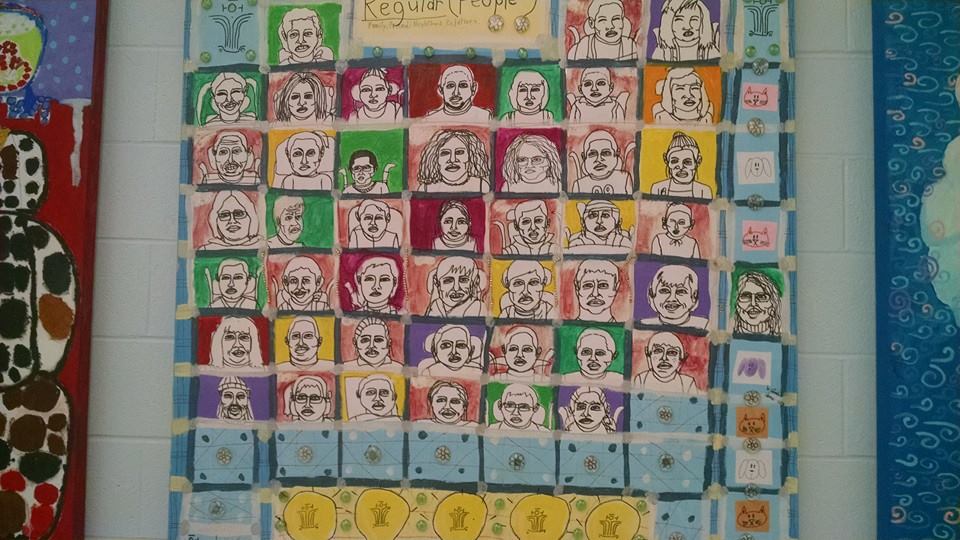
Last night we installed a show at Thunder-Sky, Inc. that is dedicated to that place. "The Master of Loyalty Is in the Gallery Tonight: Art about Antonio Adams" is a show being curated by Lindsey Whittle, and exhibits works about Antonio by artists who know and love him like I do. It was a pleasure to see these folks' responses to Antonio's ability to pull people together, to feel that kind of love for him. In the photo above, he's standing in the middle of the gallery, surrounded by all that love, and it totally reminds me of those first few moments when I came to know him back in 2000: Antonio in his bedroom, surrounded by that army of cat sculptures, as though he was simultaneously in the real world and inside his own head. Now he is in an art gallery being celebrated.
It's been a beautiful journey with him, from those first art shows in the early 2000s to starting and helping to sustain Visionaries + Voices throughout the rest of that decade, to opening Thunder-Sky, Inc. in 2009, to now.
Without him, there would have been none of this I don't think.
Please join us on August 12, 2017, 6 to 10 pm, at Thunder-Sky, for the opening reception of the show.
Thanks.
Saturday, September 10, 2016
Yours Truly
Tomorrow we're going to be pouring the concrete platform for the permanent sculpture commemorating Raymond Thunder-Sky's cultural status here in the area. I've written so many times about Raymond sometimes I think I'm really not writing about him anymore, just telepathically conveying what he means to me over and over until the meaning becomes my status of things, the way I hope people see the way I think. Raymond, to me, was a godsend because he helped me in many ways imagine and re-imagine what I wanted to make happen in the world, as well as how to survive what happened once things get put into place.
That may sound odd, but Raymond was a specter of survival more than anything else; he used the world to his purposes and found ways to keep going even though the world often seemed not to care. His ghostliness, his weirdness, made him more powerful and yet also easy to dismiss, and his art, elemental and hilarious renderings of destruction and madness and creativity done in Magic Markers, has that same quality: some people look at what he did as endless unnecessary doodles, others as social commentary, and then others (like me) simply a vibrant, anarchic diary of existence translated through a need to be seen while disappearing.
Here's the official data about the sculpture:
“The Raymond Thunder-Sky
Spirit Tower”
The Center for Great
Neighborhoods
“The
Raymond Thunder-Sky Spirit Tower” is an outdoor sculpture created by renowned
international sculptor Tom Tsuchiya, commemorating the life and legacy of
Raymond Thunder-Sky, a Native American artist (also labeled with a
developmental disability) who traveled around the region dressed as a
construction worker and clown, drawing construction and demolition sites in
Cincinnati, Dayton, and Northern Kentucky.
He left behind over 2300 drawings after his death in 2004, and these
drawings, along with many of his tool-boxes, costumes and other items, are
archived at Thunder-Sky, Inc., a gallery opened in his name in 2009 in
Cincinnati. Mr. Tsuchiya has completed many private and public sculpture commissions,
including statues of Cincinnati Reds players at Great American Ball Park,
completed in 2004. In 2009, he was
commissioned to create the "Madden Most Valuable Protectors Award,” the
trophy that is annually given to the National Football League's best offensive
line. Other works have been exhibited at Cincinnati's Fountain
Square, New York City's Grand Central
Terminal, and Washington D.C.'s National Mall. On September 15, 2016, 4 to 7 pm, “The
Raymond Thunder-Sky Spirit Tower” will be unveiled at the old Hellmann Lumber
Mill at the corner of Fisk and MLK (formerly 12th street) in Covington, the new
office complex for the Center for Great Neighborhoods. During the unveiling ceremony featuring Tom
Tsuchiya with give a short talk about the creation of the sculpture, as well as
what Mr. Thunder-Sky meant to his creative process. As well, inside the Center of Great
Neighborhood’s new offices, works by local artists commemorating Mr.
Thunder-Sky’s legacy will be presented, as well as a video documenting an
educational program that took place at the Carnegie this summer in which Mr.
Thunder-Sky’s drawings were used as inspiration for short plays. “Demolition Man: Selected works from the
Raymond Thunder-Sky Archives,” the first retrospective of Mr. Thunder-Sky’s
works since his passing in 2004, opens April 28, 2017 at the Carnegie. All of Mr. Thunder-Sky’s drawings can be
viewed at www.raymondthundersky.org.
Bill met Raymond back in 1999. He introduced me to Raymond's drawings before I got to meet the man himself, and I was kind of blown away by the simplicity of his art's philosophy and execution. Bill and I were members of an artists collective in Cincinnati and so we were able to curate/sponsor Raymond's first show of drawings. From that a lot of things unfurled, including a relationship with the great Antonio Adams, lots and lots of shows, eventually founding a non-profit called Visionaries + Voices and opening a studio in Essex Studios in Walnut Hill which was modeled on the artists collective we were in. And then V+V transforming into an organization/studio solely about artists with disabilities, and then Raymond passing away in 2004, and Bill and I helping V+V to grow into 2 facilities/programs with a staff and clientele. And then figuring out we needed to keep Raymond somehow in the mix, in 2009, we left V+V and started Thunder-Sky, Inc. in order to reclaim that sense of art without labels, harkening back to that moment when Bill first showed me those Raymond drawings in 1999, using that nostalgia and stubbornness to keep ideas and aesthetics in the mix without the diagnostic/programmatic/charity overlay.
For seven years we've kept it going at Thunder-Sky, Inc.: exhibits and stunts and events that feature artists of all socioeconomic, cultural, educational, etc. backgrounds showing what they can do under the regal banner of a Native American construction-worker dressed up like a clown with a tool-box of markers, getting a kick out of how people build things only to tear it all down and rebuild. Rinse and repeat.
And now a great sculptor named Tom Tsuchiya has generously created a wonderful monument to Raymond. When we pour the concrete tomorrow (ironically on the anniversary of 9/11, which is completely unintended and yet kind of brilliant without being brilliant), I'll be thinking of Raymond Thunder-Sky not as a memory but as a force of nature, a weird silent asteroid who came through this area and paved the way forward for a lot of human beings, including yours truly.
To Raymond.
Below are photos with captions of some of the history of Raymond's life, and the history of the sculpture.
![]() |
| 1999: Raymond with Paul Rowland and Antonio Adams outside the Base Gallery in Over the Rhine, where this whole shebang started. |
![]() |
| Raymond drawing, with a mention of Covington, Kentucky. |
![]() |
| Antonio with a print of a drawing of Raymond by David Mack, circa 2012. |
![]() |
| Drawing of the concrete platform and the Raymond Thunder-Sky Spirit Tower by Sculptor Tom Tsuchiya. |
![]() |
| Tom with a replica of the Spirit Tower. |
![]() |
| Plague for the Raymond Thunder-Sky Spirit Tower. David Wecker was one of the first journalists to write about Raymond. |
![]() |
| Tom Tsuchiya's plan-out for the sculpture. |
![]() |
| Raymond in Chicago, by the then-named Sears Tower... |
Sunday, May 8, 2016
I'll Stick with You Baby for a Thousand Years
Last Friday, April 29, 2016, we hosted a great big extravaganza at Thunder-Sky, Inc. that allowed me to understand better why we keep doing Thunder-Sky, Inc. Upstairs it was "Radically Visible," a fashion-show/danceathon/performance-art-glitter-fest, with Sky Cubacub, Lindsey Whittle, Antonio Adams, and Craig Matis all delivering the goods in the form of neon-colored fashion, ecstatic make-up, big gaudy collages, gloriously stylized poster-sized photos, and the kind of energy that helps you to re-invigorate what you want not only out of art, but out of life. It was like an extended funky parade all night, all that electricity boxed in and vibrant and burning in all directions, and by the end, when everyone was dancing and carrying on, the floor felt like it was about to collapse. That almost collapse is what "Radically Visible" was truly about, a beautiful crew of artists and models and everyday people blending into one big bombastic moment when snobbery and skepticism leave the room to go sit outside in their cars, and vision replaces judgement: all feeling, walls and floor shaking like a kite blown around by wind. All smiles, sweat, and silliness. You don't need anything else sometimes.
And then downstairs we were doing a David Bowie tribute (curated by Emily Brandehoff) that pulled together over 40 or so artists' visions of what Bowie meant, our basement wall-to-walled with interpretations of his greatness. Crayon drawings right next to oil paintings, conceptual found objects situated with upfront portraits of the artist as he was, as he wanted to be. Bowie's world was about being radical and visible too, of course; he was always in search of some otherworld to replace the glum, phony one we're all usually stuck with.
We karaoked the hell out of some of his greatest songs in that basement. And as I screamed out the lyrics to "Golden Years," I felt somehow vindicated, although I really didn't understand the point of the vindication outside of the fact that we are keeping Raymond alive in the humblest of ways, dedicating art and time to his memory, archiving almost everything he left behind: Raymond Thunder-Sky, urban legend and Cincinnati curiosity transforming year by year into mythological god and mentor. And mid-song, my lungs burning from me trying to imitate Bowie's angelic/demonic baritone, I realized I was staring up at the shelves holding Ray's toolboxes, all those toolboxes he carried around town as he rode buses to get to demolition sites so he could draw them. Those metal and plastic boxes contained his drawing supplies, candy, photographs, pieces of his ongoing clown costumes...
Everything we do here celebrates the triumph of his strangeness, the rigor of his freakishness.
I'll stick with you baby or a thousand years
Nothing's gonna touch you in these golden years...
Saturday, April 16, 2016
Raymondism
![]() |
| Raymond Thunder-Sky |
![]() |
| David Bowie |
![]() |
| Lindsey M Whittle |
We're opening two shows this month at Thunder-Sky, Inc.: "Radically Visible," featuring costumes, photos, collages, drawings, and other art by Antonio Adams, Sky Cubacub, Craig Matis, and Lindsey M Whittle, as well as a group show curated by Emily Brandehoff, "Bowie in the Basement," featuring about 40 or so works from a variety of artists, celebrating Bowie's life and art. When I was pulling together news release info, I came across the above three photos, and they've stuck in my head, so that means of course a blogpost about Raymond, Bowie, and radical visibility, but also beyond that I wanted to reconstitute a little of Raymond's myth and menace and glory, conjure up his presence from back in the day, when people did not know what the hell to do with him. And despite a lot of bull-shit he persevered, finding a way to be what he wanted to be, who he wanted to be.
Raymond had no choice really in that department. For him, costume, performance, art, life, and being Raymond all intermingled into one sensibility that seemed forever eschewing conformity but also never flaunting the eschewment self-consciously. I am what I am so just get fucking used to it -- that's all over his face in pictures, especially in the one up top. He toured Cincinnati like that, all clowned- and construction-workered-up, silently going about his obsessive business of drawing from real life the destruction and construction people did to their surroundings, haters be damned. And there were haters, people who treated him like a freak without kindness or even just plain everyday manners. I'm not going to go into those stories because they don't matter here. He survived, created his own universe, found a way to make meaning out of what he wanted the world to be.
He left behind those costumes too, which we've archived at his joint: hard-hats, clown-suits, boots, overalls, clown-collars, hats. Shininess juxtaposed with burlap ruggedness, a show-off propensity pushed up against the need to be part of a team. At the end of the day he merged show-business and working-class desires, furtively and yet also somehow loudly proclaiming his right to be a great big beautiful freak, while also trying to invent a job for himself. (His construction-worker drag came from the fact that he truly wanted to be a construction-worker. He actually started putting on the work-clothes and showing up at sites with his drawing materials because he couldn't get hired on as an actual construction-worker [he didn't have a driver's license so they couldn't]. He willed himself into that status through a sort of flaky and beautiful camouflage.)
The freakishness and the self-created celebration of the freakishness go hand in hand with Raymond. He was his own one-man band in many, hermetically sealed ways, but also willfully open-ended, walking and walking and walking in that get-up all over the city, riding buses, being a part of the world bubbled-off but completely in the maelstrom, a sort of Native-American-Shriner's-Clown-Working-Class Dandy.
Nineteenth Century poet and philosopher Charles Baudelaire was always riffing on and refining his metaphysical takes on the "dandy." He defined dandyism as an elevation of aesthetics to living religion, that a dandy in his finest fineries simply walking about the wretched city, shining like some self-created aristocrat, pisses off the responsible citizenry existentially because the dandy has paid so much close attention to his own existence and identity outside of the realm of their control, and their taste, their lives.
Casting Raymond as a "dandy" kind of helps situate and contextualize what the artists in "Radically Visible" will be up to, as well as gives some backroom logic to "Bowie in the Basement." In their work, Sky Cubacub is on a quest to reestablish the meaning of fashion and clothes as both demarcation and demonstration of the way someone should be able to live and love. Antonio Adams, one of Raymond's best friends, carries on Raymond's legacy through his own sense of kingly garments and a continuous reinvention through art of his own mythologized self. Lindsey M Whittle takes silliness and freakishness in as forms of alchemical oxygen, breathing out little kingdoms of goof and color, and Craig Matis' collages use the circus, itself a version of over-the-top captivity and release, as metaphor for reconfiguring the struggle to be exactly who you need to be, no matter what constraints and condemnations.
Then there's David Bowie, king of the dandies, shape-shifting his way from space-cadet to thin white duke to harlequin and beyond. Bowie has left behind a legacy of I-am-what-I-am-so-fucking-get-used-to-it; he managed to change the world by appearing not to be in it. Somehow he was able to crack the code of all clowns and freaks: be exactly who you are until the day you die.
Monday, December 14, 2015
Thunder-Sky, Inc. 2016: Radical Approaches
This will be our seventh year in existence, and the collection of exhibits we’ve pulled together represent Thunder-Sky, Inc.’s vision and mission pretty spectacularly: paintings, costumes, sculptures, installations, performances, shadow-boxes, songs… All of these artists have totally different and divergent approaches, all of them “radical” in ways you’ll need to see to believe, and all with a distinct and powerful sense of authority and ingenuity in sync with Raymond Thunder-Sky’s legacy.
January 9, 2016 – February 13, 2016: “The Garden of Restoration: New Works by Tom Towhey and Adrian Cox.” Two veteran, skilled painters, one from
Cincinnati (Towhey) and the other from St. Louis, Missouri, create works that
are disturbingly plush and whimsical but also have the depth and cunning of
masterpiece daydreams. Hieronymus Bosch
and Salvador Dali can be used as reference points, but then both painters slide
away from reference into their own versions of paradise and the opposite.
February 26, 2016 – April 9, 2016: “Utopia Parkway Revisited: Contemporary Artists in Joseph Cornell’s
Shadow.” Joseph Cornell was an “outsider artist”
before “outsider art” was engendered as a label. In the early 20th Century, he
lived in Queens, New York with his mom and brother, and created a secret world
of shadow boxes, movie-star dossiers, collages and home-movies that are seen
today as remarkable works of art. Local
artists Jeff Casto, Marc Lambert, Christian
Schmit, Matthew Waldeck, and Matthew Waldeck Jr. make art that both mimics
Cornell’s approach (collage, sculpture, assemblage, and appropriation), as well
as the spirit involved in his vision, creating and recreating an aesthetic
universe based in nostalgia, obsession, and pop culture.
April 29, 2016 – June 11, 2016: “Radically Visible: Sky Heyn Cubacub, Lindsey Whittle, Craig Matis, and Antonio Adams.” Cubacub, Whittle, Matis, and Adams are artists who use costume, performance, music, language, and symbol as vital ways to break down the barriers between artists and audience, and to both celebrate and invigorate the conversations and tensions around identity, appearance, and meaning. The works in the show range from costumes, performances, songs, paintings, drawings, and collages.
June 24, 2016 – August 13, 2016: “Dollar General: Installation Art by The Girls Coloring
Space.” Krista Gregory, Jamie Muenzer and Kathy
Brannigan comprise the artists collective The Girls Coloring Space. The premise of this show: Thunder-Sky, Inc. is awarding a $100.00 grant
for materials to The Girls Coloring Space with the stipulation they must spend
the 100 on materials at a local Dollar General store. That will be the only materials they can use
to make art and/or to install the show outside of the white-paint and spackle
and nails the gallery has on-hand. The
Girls Coloring Space has the wit, ingenuity, and sense of intuitive style
needed to make “Dollar General” an aesthetic and commercial success.
August 26, 2016 – October 8, 2016: “Well-Known Pacifically: New Works by Antonio Adams.” This will be Antonio Adams’ 2nd one-man show
at Thunder-Sky, Inc., and his 3rd installment of a series works that
began with “Unrealized & Unforeseen” in 2012 followed by “Outcasts from
Hollywood” 2014. In “Well-Known
Pacifically,” Adams’ continues to explore his technicolor notions of celebrity
and reality with a sense of mischief, comic grief and funky spirituality.
October 28, 2016 – December 10, 2016: “Flourish:
Cindy Dunham and Carla Knopp.”
Two artists from Indianapolis work in different modes and scale, but
find common ground in the gallery space.
Dunham draws and makes intensely-colored digital prints from the
drawings. Knopp, a painter and sculptor,
will be featuring sculptural pieces that have the shape and form of phantom
wild life.
Saturday, November 21, 2015
Get with the Program
It's been a week. The highlight was last night, when Antonio Adams was part of a big gig downtown Cincinnati at the Weston Gallery. He created a huge assortment of sculptures for "GIMMIE GIMMIE GIMMIE," a show curated by artist Todd Plavisko. He created the pieces for about ten months in the Thunder-Sky, Inc. basement -- lots of hard work, inventiveness, Antonio's usual. And he came to the opening last night in full seersucker-and-face-mask regalia. Look at those shoes too. The sculptures, kind of like enlarged Christmas toy soldiers, lined the windows of the place, on guard and protecting whatever needs protecting. Antonio's mom and family came, and lost of friends, supporters...
A couple days before, I was in Columbus at a conference about people with developmental disabilities getting employed in real jobs. The main speaker, a soft-spoken bureaucrat with blank-cut hair and a sweet face, said something that has stuck in my head. She said she has to keep correcting herself from using the word "program." She said that she's trying to rid her vocabulary of that word, in order to replace it with "supports." "Program" is no longer the go-to bureaucratic word when talking about services for people with disabilities.
Semantics is often a way for bureaucracies to skirt the issue, and to move the emphasis from actually doing something to talking about doing something, and I'm sure that's a strategy at play here in Ohio, where all kinds of changes and forces are in place now to desegregate people and reinvent "programs" that are "supporting" people with developmental disabilities to become a part of the "community." I put air-quotes around "programs, supporting and community," because I want to figure some stuff out, to detangle the language from the practice maybe. Those three words are the holy trinity of the way we all B.S. about how to help people with developmental disaiblities, as well as how tax-payer money gets spent on doing it, so those words become freighted with meanings and non-meanings that we all take for granted. The speaker at the conference Wednesday, when she said she was intentionally eradicating "program" from her bureau-speak, seems to be making a pretty smart move, keeping in mind it's still just a move in an ongoing dance of course.
What does "program" actually mean. Straight from the dictionary: a plan of things that are done in order to achieve a specific result. So in trying to rid the world of that moniker, I guess, the bureaucrats who oversee policy and funding are trying to get at the way we organize our activities in the helping-people-out biz around plans and results. What have we wanted to accomplish all these years? (I've been doing this stuff for close to 23 years now, trying to help people with developmental disabilities be a part of the "community,"etc.)
What results have actually happened? We've had great intentions but hardly any results that actually do anything beyond setting up "programs that support people to be in the community." Air-quotes again. We set up programs in order to set up programs that are done in order to achieve the sustaining of programs. I know all of this by heart. I help set up a program called Visionaries + Voices that did not start out as a program. It started out totally grass-roots without a plan and then got a series of plans that morphed into "programs." The plan at the beginning was to create a studio where any artist who needed support of any kind -- artists with or without disabilities -- could get it. But then we started to realize that the majority of the artists who were becoming a part of V+V had disabilities, and from that realization came another realization: V+V needs to become a program because programs get grants and government funding. We pursued program funding then; we became a program so we could be a program. That tautology ruled for the majority of my tenure, and we snowballed into segregation pretty smoothly, starting out in a building with a bunch of other artists and eventually realizing we needed to leave and have our own place, and then another place, and then we went from 10 artists to 100 in what seemed like overnight.
A program is born.
Results for that program were judged by programmatic measures: numbers of people served, how many staff hired... Columns of grant-proposal spreadsheets dictated behavior. And so on.
I left V+V in 2009, and so did Bill, my partner who helped set it up along with other great people who got hypnotized, I think, by the notion that we were onto something here; our telescope hit on a target. We didn't just have a ragtag group of artists helping each other out. We had us a great program. All we needed to do was perfect it.
The soft-spoken bureaucrat on Wednesday was letting me know (unintentionally -- she wouldn't know me from Adam) that we should have never pursued ProgramLand. But you can't put that genie back into the spreadsheet column. All you can do is move on. And that's what we all have done. V+V is a program that's doing great work, albeit in the form of yup programming.
But the original intent of the whole she-bang wasn't programmatic. It was supportive. That binary is useful. You don't have to have a program to offer someone some help. Antonio's picture above is proof of that. He left V+V about the same time we did. All three of us were integral in making the thing happen, and yet we decided we couldn't be a part of it any more and came up with Thunder-Sky, Inc., in Raymond Thunder-Sky's name, the artist whose bravery and spirit started the whole stinking journey. And since 2009 we've been "not a program," but a collective of artists supporting each other. Not 100 artists by any means, not even 25, but we do OK. Nothing to brag about. But why would we need to brag anyway?
Now, besides Thunder-Sky, Inc., I focus solely on helping people with developmental disabilities get employed. Going through all that ProgramLand turmoil is the main reason I think I've gone down this path. It's a hell of a lot harder to help someone figure out where they fit in in the actual world than where their place is inside ProgramLand. You have to know them really well, what they can do, what they can't, what they're interested in and how that interest fits into the actual world around them. How do you help someone become a part of the community? That's community without air-quotes. First they need some kind of economic self-sufficiency: they need a job. A lot easier said than done, and a program that focuses on that result really isn't a program in the conventional sense any more because the "results" of the "plan" are to support folks enough so they no longer need the program -- to help them get to the point where a program is no longer necessary.
It's a beautiful conundrum. One I keep trying to figure out.
Maybe Antonio already has though. He works part-time bussing tables, spends a lot of his time making art, perfecting his opening-night outfits, and being a part of -- you guessed it -- the community. On his own terms.
Friday, August 14, 2015
Ghostliness
Monday night, we started with this little ensemble when looking at how to curate "The Goodwill Biennial," the next gig on deck for Thunder-Sky, Inc. It's a parody of contemporary art-survey biennials across the world, using donated paintings, sculptures, whatever given to the Ohio Valley Goodwill here in Cincinnati as the starting point of a jurying process that includes me, Bill Ross, Matt Distel, Merry Hoefle, Melanie Derrick, Emily Brandehoff, and Antonio Adams. Parodying something as pretentious and serious as a "biennial" is kind of a silly prospect of course, close to shooting million-dollar fish in a million-dollar barrel: those who pursue the biennial lifestyle of course don't give a crap, and those who don't give a crap really don't care. But still satirizing something so contrived and so integral to the way serious art business often gets done (or doesn't get done) gives us a chance to worship at the altar of Pure and Gorgeous Serendipity, as well as the sad and blurry cathedral of Musty-Smelling Ghostliness.
That's definitely the vibe when unpacking donated art: that mildew-enflamed fume, that sad sweet grandma-doesn't-live-here-anymore vapor. In fact, those delicate, precise, dreamy watercolors of 1960s suburban homes surrounded in trees and sunshine had to be unpacked from a mysterious blue suitcase filled with old sketches and photos and prints someone had stuffed into it and locked up tight and sent on its merry way. That blue suitcase mustiness was an entrance into memory, kind of like the marmalade on the cracker moment Proust went on and on and on about. Those drawings have such a tenderness, such a nostalgia, and then Matt located the centrifuge of this whole vortex by grabbing the portrait in the center from off the floor, and there she was: Nancy Kincaide, a name we all brainstormed into being. She was a realtor, a murderess, a vindictive socialite and so on. The painting itself is green and heavy and small, and Nancy's countenance both regal and also beautifully come-hither. By juxtaposing the houses with her circumspect portrait Matt intentionally created a tableau that is easily understood but vast with mystery, story after story spilling out of those dark windows, those water-color driveways.
And that's kind of what the whole show is about, dislocating kitsch from all those tossed-aside, handmade objects and finding a way to take seriously what was recently in a canvas bin inside a large warehouse in Woodlawn. Thankfully all the Goodwill staff were game, and thankfully we have some likeminded souls helping us find our way through. But the sentiment is serious, and as we juxtaposed and figured out where things went on Monday night it all became a little emotional, in the way maybe you might feel helping people escape from a prison-camp: there's an odd and kind of exhilarating freedom to reconfiguring what destiny has tried to create and sustain. This stuff was supposed to be either thrown away or tagged and put on a shelf, and here we were thinking about it, playing with it, introducing ourselves to it in a way that wasn't about anything other than making some kind of moment, or series of moments, happen. That's the ecstasy of pure aesthetics right there, taking what's trashed and forgotten and un-trashing it and remembering it in such a way that poetry and a little bliss coalesce, appear and then disappear.
Nancy Kincaide wholeheartedly agrees. Just ask her.
Saturday, July 18, 2015
Raiders of the Lost Art
| Kevin White |
It was one of those "now and then" kinds of things. Odd enough to inspire a blog-post I guess, even though the older I get the more I try not to pay attention to the "now and then" and just keep in the now. Things feel saner that way, less philosophical, less like you are imposing "sense" on something that just doesn't make it. But this one hit me right in the face.
In 2001 or so, right when Bill and I were feeling the first excitement of helping a few really great artists with developmental disabilities get some supplies and attention. Right when we were in the thick of inspiration, we helped 3 of those artists (Kevin White, Mary Flinker and Antonio Adams) do an installed mural consisting of paintings and assemblages at Bobbie Fairfax School (a school for kids with developmental disabilities) in Cincinnati. So last Friday I had to go to Bobbie Fairfax School because Star 64, a local TV station, had donated some air-time to my "now" obsession: employing people with developmental disabilities. For segments during a movie marathon, Star 64 emcee Storm (I guess it's his real name) interviewed Chase Montgomery, a guy who works full-time in a dining hall at Miami University. He doesn't communicate verbally that well, but he and his mom and dad programmed his communication device with some great answers to questions about what it means to make a living on his own. I was there to give Chase a little support:
So anyway after the interview (which Chase totally rocked) I was walking out to my car when I stumbled onto all those paintings and assemblages we did in the Bobbie Fairfax School cafeteria in 2001 with Kevin, Mary and Antonio, and it was just one of those weird feelings that happen when you aren't really ready for it. I wasn't moved to tears or anything, but I was a little stunned because it brought 2 issues together in a sloppy but somehow meaningful way.
Back then, I was majorly focused on ensuring that Kevin and Mary and Antonio (the list grew to over 100 through the 2000s) had access to cultural/artistic possibilities, with the hope that someday they would be seen as contemporaries of other contemporary working artists. And even though we were able to establish a non-profit arts organization (Visionaries + Voices) and a small, no-nonsense art gallery (Thunder-Sky, Inc.) on that quest for equality, I'm truly not sure if this ever happened. It sure was fun and exhausting trying to make it happen though.
And then that idea of doing a lot of work but not getting it all the way right, not reaching that sense of Utopia or true equality, spills over into trying to help people with developmental disabilities access good-paying jobs, which is now my total focus, my new attempt at, for lack of a better word, Utopia. It takes even more tenacity to do this because it's not just about culture, it's also about economics, a real-world self-sufficiency, and a dialog with HR managers and business owners that isn't about charity or good feeling, as much as trying to make sure the people I'm championing this time can actually do the job, side by side, with some help, but also with the expectation that they can succeed eventually on their own. I know deep down they can. It's just finding that right combination of circumstance, personalities, and wills.
Chase can. He's proven that. And many, many others a lot of people (including me) are supporting to get and keep meaningful work in the community are too. But it's a never-ending endeavor, full of complications, failures, successes, and so on.
What is "true equality" anyway? All the way through the 2000s, and even into the 2010s, I guess I thought I knew, but the older I get the more I know I don't and possibly never will. "Knowing" is a luxury, I've discovered. "Knowing" anything. So now I try to figure out things, instead of knowing them. And I wish I would have "known" this differentiation back in the day when we were figuring out how to do V + V. Because back then I thought a program could create "true equality." That sounds really naïve. Possibly stupid, but all through those years of setting up shows and writing grant proposals and worrying and being stressed and inspired interchangeably, the through-line for me was that narrative of "once we get this up and running, these artists will be taken seriously."
So I put everything I had into establishing a program and all that entails, when maybe I should have been paying attention to what programs actually do and mean. I'm still figuring that one out. Because what happened is that by helping to build a thriving program for artists with developmental disabilities I helped establish an institution that needs to be ran and financed, and that means the most important administrative aspect of it all was (and still is) making sure you have enough staff and enough money to pay staff, and in that struggle to sustain it all you kind of lose perspective, even though you gain programmatic accomplishments.
Conversely, now, as I work toward figuring this stuff out, I'm not as invested in creating programs as much as job opportunities, and in that process of course I have to assist people to access employment-support programs that supply job coaches etc., but I don't have to feed those programs anything other than job seekers and possible job leads, incentivizing (one of those wonky words every system likes to use) actual accomplishments specific to a person's life (working and getting paid is central to a majority of people's lives, no matter who you are), as opposed to a program's life.
I hope all that makes sense. Maybe it does, maybe it doesn't, but it keeps reeling through my mind.
And so that day as I walked out after the Star 64 interview with Chase and Storm, and I see those paintings and assemblages in the Bobbie Fairfax School cafeteria, it all kind of came together in a crystallized way that made me feel exhausted but also kind of okay. Look at that stuff we all did, I thought. Look at those good intentions. Look at that art, still there, in that empty cafeteria.
![]() |
| Antonio Adams |
![]() |
| Kevin White and Antonio Adams |
![]() |
| Kevin White |
![]() |
| Mary Flinker and Bill Ross |
![]() |
| Antonio Adams and Kevin White |
![]() |
| Antonio Adams and Kevin White |
![]() |
| Antonio Adams |
He's basically a workaholic, a great example of a "working artist." And like the majority of his contemporaries, he has a day job at Frisch's. He's kept that gig, as a busboy, for over 13 years, and when I asked him yesterday why, he said because he likes it and he needs to keep it because of the people there, plus he has to pay his bills.
There you go.
Saturday, June 27, 2015
Why?
So why do we keep on doing Thunder-Sky, Inc.? We're 6 years in now, and sometimes it feels like a never-ending cycle of chores -- news releases and Facebook posts and nails into walls and spackle and paint and bathroom cleaner and paper-towels and buying beer and wine and pop and ice, all in the name of curating the best and weirdest and sweetest art shows we can pull together, 6 times a year. What is it now? 33 shows so far, with maybe about the same number installed in other galleries and places across the region. God knows we don't do it for the cash. Thunder-Sky, Inc. is all non-profit, all volunteer, all kind of makeshift and holy and silly and serious and sarcastic simultaneously. It's about Raymond Thunder-Sky sure, but I think what's evolved from the initial desire to keep Raymond in the mix is this:
Antonio Adams. He met Raymond the same time Bill and I did, and he was with us through the whole V+V evolution, and when we had to find an escape and a life-raft from the whole complicated V+V thing he came with us. The life-raft was that space next to N-Vision, next to the Comet, 4573 Hamilton Avenue, Northside. And in those six years Antonio has found a voice deeper and more hilarious and smarter and assured than ever before. He uses the space during the week as a studio. He calls "Artist's Meetings" to order on Saturdays, whether other artists are there or not. He creates his own sense of super-stylish chic through costume and custom, always looking forward to next year. And look at those gloves. Damn.
Last night we opened our 34th in-house gig called "History Channel: New Art from Old Art," and as usual the opening was joyous, off-kilter, clumsy, sweet, perfect. I screwed up the wall-text with using the wrong abbreviation for "Price on Request," and Bill had a cow. But despite that (or perhaps because of it) it was still hilariously what always happens: lots of people from all kinds of different backgrounds, creeds, classes, etc., hanging out, walking around, making conversation, laughing. There was a rainbow outside above the joint for a little while too, kind of like the 5:4 decision given its own God-blessed neon light. Antonio invited his mom and sister and they all showed, and he got costumed and held court awaiting their presence. Some artists from a studio in Hamilton called InsideOut, a place, like V+V, for artists with developmental disabilities, were there, totally enjoying their little bit of spotlight, and their excitement kind of got to me in the same way seeing Antonio holding court gets me. They were all excited to see their art-history-inspired art on our humble white walls. I truly loved the work. Loved Cassie Sullivan's quilted Warhol "Marilyns" and Alicia Jones' "Frida Kahlo" painting, an astute rendering of the artist as both goddess and cartoon and David Campbell's beautiful and fragile and kind of satiric take on Grant Woods' "American Gothic" sour-pusses... Hanging with the InsideOut-ers was a flashback to the days when Bill and I were pulling together gigs for the artists with disabilities we'd stumble upon doing out regular work, that sense of discovery and bliss, like art can truly matter when you let everything else go.
The other artists we've gotten to know through Thunder-Sky, Inc., some labeled, some not, were there last night too, hanging out. Marc Lambert, super-genius painter of sci-fi visions on ceiling tiles, contributed an archive of Styrofoam pharaohs and a couple ceiling-tile Sistine-Chapel fist-bumps to "History Channel," and he came to the opening with his whole extended family all dolled up and pleasant and affable. Robert McFate did a great Cincy riff on Hopper's "Nighthawks," and Emily Brandehoff came up with some great historical zingers, the best of which combines Goya and the snack-meat product Slim Jim's. It's to die for. Scott Carney merged Japanese nautical art with Peter Max. Alex Bartenberger Rothko'ed it up. Avril Thurman took on Jenny Holzer in the best teletype kind of way. Dale Jackson turned Yoko Ono's instructions from Grapefruit into gorgeous recipe cards. And Antonio took on Da Vinci, Michelangelo, Thomas Hart Benton, all in a deluxe super-Antonio manner.
It's all like that: arbitrary, heart-felt, odd, but exactly what it should be.
We're not creating anything institutional or pretentious or even practical at Thunder-Sky, Inc. We are not building it to last, because nothing really does. Just take a look at Raymond's drawings and you'll get that doom validated and made fun of. What we do at Thunder-Sky, Inc. is very momentary and slap-happy because it has to be: we only want what is authentically here, weird enough to tickle us, solidly made, simply presented, but also nutty enough to not be like anything else.
And then everybody gets together and eats potato chips. And drinks some beer and wine and pop.
Last night was such a great example of why we do it. So thanks to everybody who does it with us.
And then when we got home on CNN President Obama was singing "Amazing Grace."
Sunday, February 22, 2015
"The Master of Loyalty Is in the Gallery Tonight"
![]() |
| Antonio Adams, "Unrealized and Unforeseen Day," acrylic on canvas, 2012. |
![]() |
Antonio Adams, Cedric Michael Cox, and Artworks apprentices, "Raymond Thunder-Sky Mural," on the outside of Visionaries + Voices, finished 2009. |
Antonio Adams, "The Master of Loyalty Is in the Gallery Tonight," marker on paper, 2012 |
Antonio Adams teaching a class at Miami University, 2012. |
![]() |
Raymond Thunder-Sky Polaroid, with clowns, date unknown. |
Raymond Thunder-Sky, "Wrecker Tear Down Old Middletown Nursing Home," marker on cardstock, date unknown. I wrote the essay below a couple years back for a show at Thunder-Sky, Inc., but I forgot to use it. Found the doc in an old email file. It's all about Antonio and Raymond, and everything. These photos were in the same file. I think I was going to do a little booklet or something, but it seems like a really good blogpost too... Antonio Adams wears an elaborate costume to every art opening he attends. Made from felt, glitter, and fabric paint. Antonio calls it his “Art Thing Kingdom Master” attire. A triangular facemask shields the bottom of his face, and on his head he wears a crown. Antonio features himself in this costume in many of his drawings and paintings as well – most significantly in one of his latest works, “Unrealized and Unforeseen Day,” a large 5’ X 4’ acrylic-on-canvas. In this vibrant, rigorous painting, Antonio as the Art Thing Kingdom Master presides over a crowd of “regular people” being summarily transformed into heavenly celebrities, while the “bad celebrities” scale the brick walls surrounding a majestic stage with tears burning in their eyes, unable to get into the Kingdom. If “Unrealized and Unforeseen Day” is a revelatory moment for Antonio, it’s because since 1999, when he was a lonely depressed high school student with a learning disability, he has been diligently building a visual and moral philosophy that has sustained him through a lot of stress and strife, including the untimely death of his mentor and friend, Raymond Thunder-Sky. Raymond was a fixture of downtown Cincinnati street-culture for over 20 years before Bill Ross (my partner and co-founder of Thunder-Sky, Inc., the art gallery we run in Raymond’s name) found out he was secretively making incredible drawings in 1999. A social-worker assigned to help Raymond toward the end of his life, Bill at first was taken aback by Raymond. A Native American whose father Richard Bright-fire Thunder-Sky had been a Mohawk chief and a Hollywood actor in the 1940s, Raymond was known as the Construction Clown by those who would see him walking down city streets in a construction-worker/clown costume, a huge toolbox in tow. He spent much of his time traveling to, and drawing, buildings being demolished at sites all over town. At a meeting one day held to discuss Raymond’s deteriorating health, Raymond pulled out a stack of drawings from one of his toolboxes. Bill was flabbergasted. Raymond’s drawings are done mostly in pencil and magic-marker, and depict buildings being torn down and replaced by imaginary facilities with titles like Clown Suit Factories and Card Trick Amusement Parks. Each drawing is organized straightforwardly, with imagery of construction and demolition festooned with a few lines of narration in a careful script. In one archetypal drawing, a movie theatre is gutted, with a wrecking ball suspended above the wreckage, a nearby caption reading: “Last showing at Old Valentine Theatre in Downtown Toledo Will Being Torn Down to Clearing Way for New Ringling Brothers & Barnum & Bailey Circus Store.” (The whole archive of Raymond’s 2200+ drawings can be seen at www.raymondthundersky.org.) A few months after meeting Raymond, Bill and I met Antonio. At the time, Antonio was 19 and barely speaking. Bullied at his high school, he took comfort in creating art as a way to endure isolation. At the time, he was making cat sculptures from pieces of wood he’d find. His bedroom was overflowing with them. We introduced Raymond and Antonio in 2000 at Base Gallery in downtown Cincinnati, where we were pulling together an exhibit. Antonio writes about that day, in a caption to a drawing he made commemorating the occasion: “That first time am met Raymond Thunder-Sky at Base Art Gallery he was a Native American outsider self-taught artist of clown-construction-worker. He usually very shy but he also hysterically of sitcom person.” As their relationship grew Raymond became the prime inspiration that would guide Antonio’s life, imagination, and art. In 2001 Antonio and Raymond were featured in the show we curated at Base, titled “Art Thing.” (The title came from an object Antonio had made, a tiny kelly-green felt pillow on which Antonio had written “Art Thing” in white fabric paint.) One of the first exhibits featuring local outsider artists, the show was packed and many works sold. After this success, Antonio and Raymond also showed their works at the Pittsburgh Folk Art Festival in 2002, the Outsider Art Fair in New York City (2003), and several other regional and national auctions and art fairs. In 2003, when Bill and I helped to open a studio for artists with disabilities called Visionaries and Voices (www.visionariesandvoices.com), Antonio and Raymond were the first artists through the door. I can still picture that day, a very clear and tender image: Raymond in a hardhat and clown costume, and Antonio in a t-shirt and jeans, sitting next to each other at a folding table, working on their own drawings, using pencils and markers from a shared coffee-can. A few years later, Antonio, along with artist Cedric Michael Cox and teenaged students involved in a summer art-making program called Artworks, painted a mural on the side of the building that currently houses Visionaries and Voices (now a full-fledged service organization supporting over 140 artists with disabilities in a week-day program). The mural stretches across a large expanse of the building, and features a gigantic Raymond in full Construction Clown regalia, a crane hurling a wrecking ball into a building behind him. On October 29, 2004 Raymond passed away from complications of liver cancer. The day of Raymond’s funeral, Antonio had a large, scrolled piece of paper with him at the gravesite. The service was reminiscent of Raymond’s beautiful strangeness: a Shriner’s clown read the “Clown’s Prayer” aloud (we came to find out that whenever a Shriner’s clown passes away, they have the Clown’s Prayer read at their funeral), and then an honorary member of the Sheyenne tribe oversaw a sage burning ritual. He spoke about Raymond’s spirit being scattered to the four winds. After the service, Antonio came over to Bill and me, and unraveled the scroll to show us he had drawn a hysterically funny yet vividly poignant back-story for Raymond. The resulting work of art resembles a heady, Byzantine graphic novel with funky, evangelical flourishes – Antonio well on his way to merging his imagination with Raymond’s. Throughout the piece, Antonio narrates and illustrates key semi-fictionalized moments in Raymond’s life. Each moment is titled with a year, as in, “1950: Raymond born when he was a baby.” The image that goes along with the text is of an infant Raymond, swaddled in his mother’s arms. “In 1964,” according to Antonio’s timeline, “Raymond’s dad Richard Bright-Fire Thunder-Sky and Raymond are dancing to the music of the 60s.” An adolescent Raymond (with a sort of Antonio-styled afro/pompadour) dances with his tall and regal father. In 1973, Raymond is “having a shy moment with the hippies.” Antonio’s depiction of Raymond’s death: “Raymond in Heaven with God. Raymond die for cancer, Friday October 29 2004. What a sad day.” The image is Raymond with his toolbox standing beside a large Christ figure, like brothers reuniting at a celestial barbecue. Antonio eventually appropriated the “four winds” metaphor from Raymond’s graveside service to create a suite of nine 2’ X 2’ wood-panel portrait paintings, with Raymond’s portrait at the center of them. Embellished in loud circus-neon stripes, each painting pays tribute to the people in Raymond’s life who were instrumental in showing and celebrating the art he made while he was still alive. Directly above Raymond’s portrait is a self-portrait, Antonio in full “Art Thing Kingdom Master” regalia, a direct descendent or possibly even prodigal son. The costume first came into being right after Raymond’s death in 2004, and over years evolved into the blend of superhero kitsch and Samurai finery it is today. The evolution, like all of Antonio’s art, is hyper-intentional. Antonio uses the costume as a reminder of Raymond’s status both as artist and as spectacle. The “Four Winds” suite of paintings was created for the opening of the art gallery we established in Raymond’s name, Thunder-Sky, Inc. in 2009. Antonio is currently the permanent Artist-in-Residence at Thunder-Sky, Inc., and curates exhibits, as well as oversees an art-making workshop every Saturday in the basement of the gallery. Of the 2200+ drawings Raymond left behind, about 500 of them were never completed. In 2011, as part of an exhibit at Thunder-Sky, Inc., Antonio picked four of his favorites. We had prints made of them on large pieces of paper. In six months, Antonio merged the unfinished remains of Raymond’s art with his own rich, allegorical consciousness. In each piece, Raymond is depicted as a mischievous god overseeing the destruction of the old world and welcoming in the new. Or in Antonio’s words, “The one and only construction clown who taking over the demolition.” Straddling a crane and smiling gleefully with angel wings sprouting from his clown-suit, Raymond is now, in Antonio’s universe, a sort of go-to spirit, a prophet he can consult with. All four of these drawings are now in the permanent collection of James Brett’s Museum of Everything in London, England. August 29, 2012, Antonio’s one-man show at Thunder-Sky, Inc., “Unrealized and Unforeseen,” opened. Antonio choreographed the whole reception, giving us a list of foods, people he wanted to invite, as well as a very structured layout of where each painting, drawing, photograph and sculpture should be installed in the space. The result felt as if we had been given access into Antonio’s brain, a territory of vivid colorful landscapes, stringent common-sense rules, and a penchant for tragedy and comedy blending into absurdity and bliss. He had been working on the concept for over a year, creating an epic portfolio of artworks in which famous “bad” celebrities (including Lindsay Lohan and Charlie Sheen) get “unrealized” (meaning returned to non-celebrity status), while unfamous folks (people Adams has selected from his everyday life) become major celebrities in his own personal cosmos. In the same way Raymond appropriated construction/demolition tropes for his aesthetic purposes, Antonio uses tabloid stories and reality-TV as a framework to tell his own story in each of the “Unrealized and Unforeseen” works, culminating in his to-date masterpiece, “Unrealized and Unforeseen Day.” In transforming universal gossip into personal gossamer, Antonio has reinforced a vision and morality that has been in all of his work since Bill and I first met him. It is a message of epic transformation, imagination trumping rational thought in the pursuit of truths no one is ready for. In “Unrealized and Unforeseen Day,” the message is clear: no matter whom you think you are, you’re still like everyone else, and that subjugation is your freedom, your chance at grace. On the right side of the painting, where the canvas curves over the stretcher bar, Antonio has painted a blue, translucent rendition of Raymond smiling in the periphery – always there, quiet and calm, like an angel sanely orbiting and overseeing his world.
Born
in Cincinnati in 1981, Antonio Adams has been drawing, painting and creating
since he was a little boy. Now his work is exhibited and collected
nationally. He is one of the co-founders
of Visionaries & Voices, an arts organization for artists with disabilities
in Cincinnati, as well as Thunder-Sky, Inc., an art gallery also in
Cincinnati. His sculptures, paintings
and drawings have been featured at White Columns Gallery in New York City, The
Outsider Art Fair (New York City), The Contemporary Art Center (Cincinnati),
The Cincinnati Art Museum, Base Gallery, Visionaries + Voices, the Pittsburgh
Folk Art Exhibit and Symposium, Middletown (Ohio) Fine Arts Center, Fitton Center
for Creative Arts (Hamilton, Ohio), University of Cincinnati Gallery, Kennedy
Heights Arts Center (Cincinnati), Country Club Gallery (Cincinnati and Los
Angeles), and In the Gallery (Nashville, Tennessee). His art was featured in an
exhibition at the Museum of Everything in London, England. He has an upcoming exhibit at the Westin
Gallery in Cincinnati in November 2015.
|
Labels:
Antonio Adams,
Outsider Art,
Raymond Thunder-Sky
Subscribe to:
Posts (Atom)


.jpg)

.jpg)