Showing posts with label Joseph Cornell. Show all posts

Friday, February 19, 2016

Corny

Mr. Cornell
 
Joseph Cornell is one of those peripheral and yet totally important figures in contemporary art history who haunts and informs a lot of what is made and seen today.  He passed away in 1972, and yet his influence and the scope of his ghostliness illuminate a lot of what has happened artistically and aesthetically in the 20th and now 21st Centuries.  He was humble and yet ambitious, ingenuous yet sophisticated, "outsider" yet completely in sync with his contemporaries, including the Surrealists and everything after.  He lived in a small, unremarkable house on Utopia Parkway in Queens, taking care of his brother who had cerebral palsy, and working a lot of odd jobs to sustain his household that included both his brother and mother.  He basically spent his lifetime outside of those activities making intricate, oddly meaningful "things" out of materials he lifted from life:  postcards, fabric, toys, bottles, glasses, etc., all usually aligned poetically and ominously in shadow-boxes.  He also made movies, created hefty dossiers devoted to movie-stars and waitresses, wrote, and even collaborated with his brother on a series of delicate drawings/collages that merged fairy-tale wishes with a scratchy/gorgeous obsession.  In fact, most of what Cornell did seemed burnished by an overarching obsession to find meaning in what is already in front of you, as if a junk-drawer in your kitchen is a primal resource for reinvention and even transcendence, every little doodad and left-behind nothing a reason to daydream, to travel while remaining still.
 
Our next Thunder-Sky, Inc. exhibit, “Utopia Parkway Revisited: Contemporary Artists in Joseph Cornell’s Shadow" (opening February 26, 2016 with a reception 6 to 10 pm and closing April 9, 2016). features beautifully and incidentally Cornell-inspired works by Jeff Casto, Marc Lambert, Christian Schmit, Matthew Waldeck, and Matthew Waldeck Jr.  They all make art that both mimics Cornell’s approach (collage, sculpture, assemblage, and appropriation), as well as the spirit involved in his vision, creating and recreating an aesthetic universe based in nostalgia, obsession, and pop culture.  Casto's works are the closest in spirit and materials to Cornell's boxes, but he also has his own sense of deadpan whimsy and ache, as if he's taken in Cornell's need to make something out of nothing and pushed resources and dreaming to their limits.  Lambert's works featured in the show respond to Cornell's use of everyday materials (Lambert paints on ceiling tiles), and also to his starry-eyed sense of cinema and history.  Lambert meticulously recreates universes collaged from movie-scenes and folklore, juxtaposing Sasquatches with pyramids, pterodactyls with UFOs, a psychic boyhood embellished with a sense of sentimental ache and poetry.  Waldeck, Jr.'s drawings have that same sense of longing for Utopian context.  Executed in magic-marker on 8" X 11" sheets of paper, they function as a sort of illuminated manuscript informed by television, solitude, and a search for more than is there.  Waldeck, Sr. creates funky, frenetic dioramas (and other contraptions) made from machine parts and other junk.  They playfully reference space-travel, carnivals, and miniature civilizations, in a Cornellian flourish and flicker.  Schmit's one piece in the show is truly masterful, and acts as both a comment on, and a rapturous biographical portrait of, Cornell, constructed with a painstaking accuracy and ingenuity pretty much akin to everything Cornell accomplished.
 
It's going to be an incredible show.
 
A lot of times I argue on this blog that biography often handicaps the way we see and consume art, that knowing that the artist has a diagnosis or hardship or whatever shouldn't get in the way of feeling and understanding the art for what it is and can be.  You don't want to lose focus or respect by attaching charity and other kinds of condescension onto the whole shebang.  But Cornell's work and life intermingle in ways that go beyond "diagnosis" and "charity."  From limited means and a "small life," he forged an incredible body of work that somehow captures lightning in a bottle every time you witness it.  He dedicated his life to minutiae and what it means when you take the time to excavate it, to reinvent and reimagine it.  He discovered vast planets inside the smallest of boxes, and allows us today to take such endeavors completely seriously. 
 
 
Matthew Waldeck, Jr.

Matthew Waldeck, Jr.

Matthew Waldeck, Sr.

Jeff Casto

A wall of Jeff Casto works
 
A wall of Marc Lambert works


Marc Lamber


Marc Lambert

Christian Schmit

Jeff Casto


Monday, December 28, 2015

Escape Artists

I wrote about a couple of local exhibits here that I loved a few weeks back (click here to take a look), and in the course of coming up with that post I stumbled onto a phrase that's kind of stuck with me:  "art escaping itself."  That idea inspired me to try to figure out what I actually mean.  I'm guessing the main function of art trying to get away from itself is so that it can become something else entirely while also drawing attention to the fact that it's actually still exactly what it is.  The whole concept is a reiteration of Jean Dubuffet's famous quote:  "Art does not lie down on the bed that is made for it; it runs away as soon as one says its name; it loves to be incognito. Its best moments are when it forgets what it is called."  But Dubuffet always goes a little overboard.  I want art not to be incognito as much as the face on a Most Wanted poster -- eagerly anticipating being caught for what it is while running away from what it does, or is trying to do.  That's the perfect nexus at least for me:  grand schemes at the service of never being assigned to a cell or a pigeonhole.  

So I thought:  what if I could curate a group-show called "Art Escapes Itself"?  What works would I choose?   I mean not for real of course, but in a little museum in Heaven with no restraints, no bull-shit.  Then I started to remember moments in my life when I was in museums and galleries and I came across works that allowed me that feeling of watching prisoners escaping, running across night-time fields, never looking back, but then again eventually caught and returned, some kind of gorgeous sci-fi escape route constantly reiterated, refashioned, reborn.  The pieces below are what came to my mind.

1.  David Wojnarowicz's "Earth," synthetic polymer paint and collage on Masonite, 1987.  I could look at this sucker all day long.  The imagery here is encyclopedic and comic-book, but it escapes those formats through glaring into a mythical sun.  You want to crawl into Wojnarowicz's atmosphere here, feel his fever, but also the picture has the innocent postcard nostalgia of a summer vacation, that boredom that produces dream-states.  He paints over the collage and collages over the paint, creating depth and shallowness that somehow interrelate, giving the whole enterprise an amateurish nervousness and a spot-on professional gloss; you feel Wojnarowicz's itch to say something he can't say, to see something he can't see. It's a pictograph of illusions and allusions, jokes and prayers, and yet when you look at it all you see is exactly what it is, a burial ground giving birth to the last stages of an empire, a compilation of  tropes and tattoos, an incantation that triggers bliss and sorrow.  Wojnarowicz, as in his other work, merges childhood's end with an adult's desire to create a Utopia that encompasses creation and destruction, train-wrecks and daydreams.   I think the main reason I see this piece escaping itself is that it is both elegantly simple and yet totally overwrought and still you only experience it as a fully realized picture divided into quadrants that seem to be telling one another about the transformative purposes of dirt:  digging, planting, burying, sprouting, escaping... 


David Wojnarowicz

2.  Cy Twombly's "Bacchus" series, acrylic on canvas, 2006-8.  These are so dumb you want to get dumb with them.  "Dumb" is their escape route.  The god of wine is talking drunkenly and loudly on his cell-phone at a party at the edge of the earth, and you're overhearing babble and bombast and bull-shit, getting a contact high.  Gigantic-assed doodles and loops executed in murderous, cartoonish red, these paintings don't really need to exist at all, and yet here they are, at the Tate Modern in London, big as billboards, loud as thunderbolts.  Twombly's style here helps him to reinvent abstraction (the way Mel Brooks reinvented the Western in Blazing Saddles), losing that calcified sense of meaning/non-meaning, and shooting for stupid in a way
that transcends stupid.  These big old wall-objects are jokes that turn in on themselves, jokes into galaxies.  They have an earnest funk to them, but also a scratchy sense of old-man lyricism, poetry that gets thrown into the trash and retrieved and stretched into myth. Twombly finds his way out of himself and his pretensions.  No longer trying to make scribbling an epic journey of the soul, now he's just going for it.  "Fuck it," says the god of wine.   Cue "Love Hangover" by Diana Ross.

Cy Twombly

3.  Robert Rauschenberg, "Melic Meeting (Spread)," solvent transfer, fabric collage, acrylic, mirrored panel, wood, and comb on wood panel, 1979.  We stumbled into this beautiful thing at the New Orleans Museum of Art earlier this year.  It's Rauschenberg mid-term, 1979, and kind of like a Fred-Astaire reinterpretation of his other earlier works, without the rust and vigor and lushness, but with a strange kitchen-curtain grace that feels like dancing with your eyes closed.  There's a memory parade here, unlike the memory stockpiling and convoys in the 60s combines (the mattress, the ram, the stuff eagle and so on):  you feel elevated not submerged.  Rauschenberg has found a way to suck in all the elements and objects humanly possible into this work without having to call movers in.  It's lightweight but fabulously so, an empty apartment full of ghosts, and the ghosts can only communicate with combs and mirrors and pictures of cats.  It's wallpaper and duct-tape and sleep, migraines and half-eaten birthday cakes and ruined Polaroids after a floor.  Someone somewhere is walking down a hallway thinking about what they are going to have for lunch as well as what it means to be alive:  banality and profundity find each other and laugh about all they have in common.  Poetry usually can't get to this place he's found.  Words are just dirty clothes on the floor.  Mr. ee cummings does find a few argyle socks sometimes though that match Rauschenberg's insights and flights:

 “though your sorrows not
any tongue may name,
three i’ll give you sweet
joys for each of them
But it must be your”
whispers that flower


Robert Rauschenberg

4.  Joseph Cornell, "Celestial Navigation," found objects, acrylic, and collage, 1958.   We're doing a Joseph-Cornell tribute show at Thunder-Sky, Inc. this year, so he's always in my head somewhere, working diligently on things like this:  carefully constructed whispers (see ee cummings above) that freeze themselves into time-machine tableaus.  This one is calibrated to narrate a story only Cornell knows, and yet you can grasp the meaning without knowing the story.  You can look at it as "art,' but also as something else entirely:  talisman, crystal ball...  Cornell arranges knickknacks and toys into incantations.  I wrote a post about 4 years ago not about Cornell, but about a blue bucket.  Here's the link:  "Little Blue Buckets".  It's a short piece about a home-visit I made and I came across a school-age kid with a developmental disability who basically worshipped a little blue bucket he kept around the trailer.  I wrote:  "The little blue bucket escaped art and has become art simultaneously.  The saying goes, "If a tree falls in the forest..."  But that's not it.  I stumbled onto a happiness and a beauty that does not need documented.  It doesn't need justified.  It's just there."  I think this is what Cornell did most everyday of his life.  He searched for ways to stumble into things; he worshiped what was right in front of him to the degree that he could alchemize everyday objects and notions into totems and triumphs.  He lived for self-imposed serendipity.  It was the way he survived.    

Joseph Cornell

5.  Judith Scott, "Untitled," fiber and found objects, 2004.  There's something about revenge here, in this entangling of yarn and stuff Scott found to take hostage; she's trying to build a nest, sure, that's the easiest interpretation.  Foraging for tubes and plastic wheels, spools of thread, taking all of that and spinning it and wrapping it into a place of rest, or maybe even restoration?  But I don't think so.  It doesn't seem restful, this "Untitled" thing.  It seems almost vicious, unnerving.  Vicious and unnerving in a good way.  Unlike Rauschenberg who fashioned his obsession with appropriation, assemblage and collage into stream-of-consciousness window-dressing, Scott's work isn't theatrical or expressionistic, as much as it is conceptual and harmonic.  She's creating and obscuring symbolisms, taking away the function of things while imbuing them with an entrapped power and focus objects shouldn't have, wrapped in yarn or not.  It's accidental, what she does, but also fully intended to show us her territory, her conquest.  She's pulling the world into her grasp one little piece of crap at a time, and giving us these sonnets and villanelles made from whatever is at hand.  The structure is key.  They don't look messy.  This one especially has a firm focus, a grim and hilarious necessity.  She's swaddling, she's capturing, she's finding a way to make sense of a world made up of so much shit it's time to get out some rope and track it all down.

Judith Scott

6.  Jean Michel Basquiat, "King Zulu," mixed media, 1986.  A theme that runs through this whole "Art Escapes Itself" motif is how the stuff I love to look at is made:  a simple, declarative ingenuity, making art out of whatever is around.  That's what I love about all of Basquiat's work, and especially this piece, which I saw in the late 1990s at the NYC Museum of Modern Art.  It's always left an impression.  That cold cobalt blue there, a wave of it splashing and focusing the picture on whatever Basquiat wants us to see; he's editing himself while also enlarging the vision.  The quality of his line and the big bang boom of his color choices give the piece energy but also a sort of sarcastic urban menace, as well as a cinematic glitter.  The thing vibrates itself out of itself, like riding a subway while on ecstasy.  His drawing has a sense of nerve leaning into nerve, an almost painful whimsy cooling into folklore.  You know what Basquiat means, but you feel the meaning like you hear music, without a sense of what is going on, that feeling/meaning/music coming through without acknowledgment, just seeping all jazzy and revved-up right into you veins, cool enough not to indicate anything other than what it wants you to know and feel head-on, rush into rush.  "Sophisticated" isn't the right word, but it's close:  Basquiat makes you understand without making you understand.   

Jean Michel Basquiat

7.  Cindy Sherman, "Untitled," photograph, 2000.  Sherman is a standup comic who isn't after laughs (even though she gets them anyway) -- she's after the feeling that comes when you can't find the laugh anymore.  This one is a fave because it harnesses the energy of a thousand suns to satirize what is already satirized and yet the disposable nature of the whole exercise gives it the kick it needs:  those sad specifics, that stupid make-up, that floppy hat.  She's making fun of the people who make fun of people, finding empathy at the end of a long day's tanning.  But it's not the kind of empathy that sells.  The woman she's depicting and objectifying has been so self-depicted and self-objectified through chemicals and other means the parody doesn't take.  That's Sherman's intention I think, and the way she escapes the easy categorizations in all of her work:  she strives for the interregnum, the in-between queasiness that's unleashed every time someone gets their picture taken, every time someone becomes a "star."  That horrible face does not know it's a face anymore.  The tan-line becomes destiny.  I even love the lush backdrop, like a popsicle melting.  But she's looking right at you.  She wants you to understand a few things.  This isn't art; it's something else, art once removed, a process of elimination.   

Cindy Sherman

8.  Mike Kelley, "Deodorized Central Mass with Satellites," plush toys sewn over wood and wire frames with Styrofoam packing material, nylon rope, pulleys, steel hardware and hanging plates, fiberglass, car paint, and disinfectant, 1991/1999.  I 've done a whole series of posts about the Mike Kelley retrospective at the MoMA PS1 space in NYC back in 2014.  That show killed me in a way no other exhibit has, pulling together almost everything Kelley made and displaying it lovingly and exhaustively throughout that huge complex:  it was Kellyland.  This installation was the centerpiece, and set the tone for the rest of the retrospective.  It truly is penultimate.  Kelley takes the same shit Scott, Cornell, and Rauschenberg do and transitions it all into a makeshift carnival of thunder-clouds and planets.  You walk around each concoction a little afraid of something jumping out at you, and yet it's all perfectly still in its floating apparatus, each plush toy anesthetized and sewn into harmony.  There are so many associations you lose count:  genocidal piles of bodies, that Princess-Diana-stuffed-toy memorial, garbage dumps, cancer-cell clusters.  And so on.   There's mystery here, telekinetic, sinister, sweet.  You know it's art, but also you don't know what to call it. Like wads of chewing gum giants have spit out. 

Mike Kelley

9.  Andy Warhol, "Little Electric Chair," acrylic and silkscreen ink on canvas, 1964.  This would be the last thing you see in the "Art Escape Itself" group-show.  A whole willful of multi-color prints of a little electric chair from 1964.  Warhol knew some things.  He obscured his knowledge often by teeheeing, or over-worshipping what was already worshipped, or by instilling a darkness over all the brands, and yet the darkness that truly registered was fashioned from a simple curiosity:   what does death look like?  How does it move through the world?  He was x-raying it here, trying to get at the glamor inside it, outside of it, like a still from a snuff film, like the dream you dream the night before...  He escapes all his bull-shit here.  He stops talking about it and gets down to business.  It's better than the car crashes and better than the person jumping out of a building.  This one has a solemnity to it, an elegance enhanced by humility and sobriety, but still a little fun, right?  Party colors.  Like balloons.

Andy Warhol

Saturday, January 31, 2015

An Apothecary of Jelly Jars and Moonlight


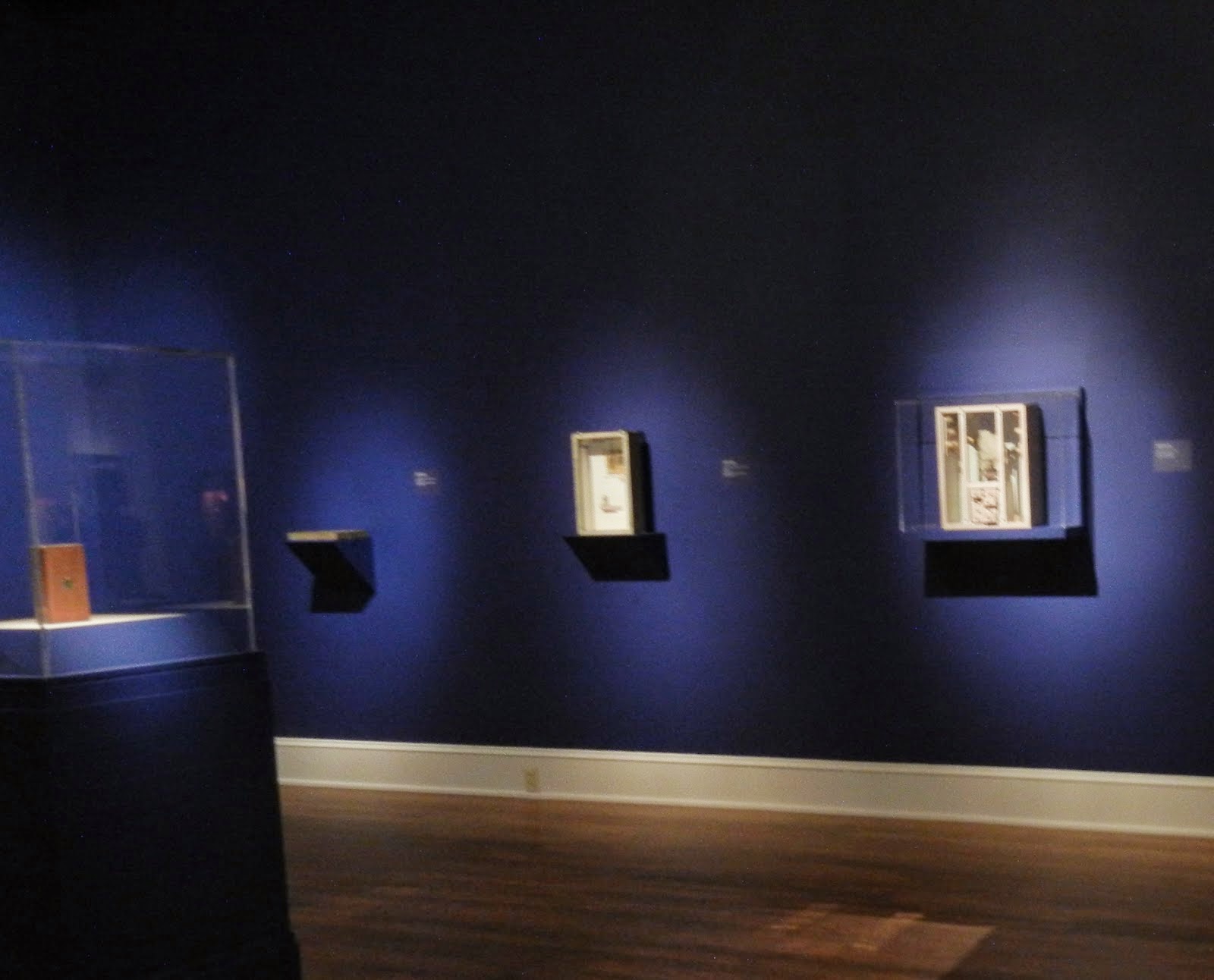
A few weeks back we went down to New Orleans to see friends, and Bill and I went to the New Orleans Museum of Art just to go there.  We stumbled onto one of those beautiful, serendipitous experiences that only happens when you don't make checklists or plans.  In 2012, NOMA refashioned their collection of Joseph Cornell shadowboxes, collages and dossiers into a self-contained universe with dark blue walls and intergalactic spaceship lighting that allows Cornell's world to sustain itself as both playfully serious and transcendently whimsical, a rare concentration of his works that allows you to quiet yourself down long enough to understand he was probably one of the greatest artists of the 20th Century.  And not because he was a part of a trend or reflected the turbulent times he lived in or whatever, but truly because he found a way out of all of that, and into a poetic century all his own.  He was making places for himself to escape to, dreamlands constructed from cracked window-glass and old toys, white-washed lavatory doors, forgotten wire in a junk-drawer, cobwebs in a corner crystallizing into words and phrases that never get said just evoked, unspoken yet vibrating.  The room of his work at NOMA opens up into its own versions of shadowbox intimacies; you want to go to sleep inside each of his pieces, find the dream he was dreaming the moment he made each one.  He was one of those people who could not find any other way out of himself other than through recognizing what he craved and fetishizing it into his own self-made religion, worshipping hotel corridors, magic tricks, sand on shoes from the beach, postcards inside shoeboxes, mystical moments you have that always go unsaid, that intricate form of daydreaming that allows you to find a whisper even inside a hive of bees.  He was a master storyteller who found epic narratives within empty pill bottles; he found hope in paint chips and discarded envelopes.  I kept walking back and forth among the pieces there at NOMA, not wanting to know titles or dates, but just luxuriating in the fact that they have been so beautifully preserved, tiny interstitial sentences, images, objects, minutes, days, all of it self-contained, an apothecary of jelly-jars and moonlight, misery unraveled by tenacity and determination.  Joseph Cornell knew what he was doing every step of the way, those collages and shadowboxes let us know:  he found his way through by working everyday of his life on a project he could only see one small puzzle-piece at a time. 
 

Sunday, April 7, 2013

Don't Quit Your Day Job

 
Bill, Antonio and I had lunch at Dusmesh today, this little Indian restaurant near Cincinnati State in Clifton.  The buffet is amazing.  I wanted to touch base with both of them about the idea of supporting creative, hard-working, unconventional people (like Raymond) to get jobs, using Thunder-Sky, Inc. as the platform.  So I asked Antonio what he thought, and one of the first things he said:  "Don't quit your day job." 
 
He also said, "You can be an artist but you can't sacrifice yourself."  I asked him what he meant by "sacrifice," and he said, "You have to make yourself a living.  You have to have a roof over your head."
 
We talked about employment for people with disabilities and how Raymond was a prime example, and how Antonio is a living example.  Antonio went through his mental Rolodex and out came all the jobs he's had since high school:  a lumberyard, a Blockbuster video, Goodwill, and since 2002 where he is working now, Frisch's Big Boy Restaurant.  He said he has been there at Frisch's so long that he now trains in bussers, showing them how to do tables right, how to unload tubs, and where the trash goes.
 
Bill and I also talked about how Raymond used to go to Goodwill over in Woodlawn, and Antonio said that he and Raymond sometimes used to work side by side there, before Antonio got his job at Blockbuster.  What a beautiful image that is:  two great artists and people working very hard during the day, and individually making works of art whenever they could.  Evenings, weekends, afternoons after work.  If made me think about how working a job sometimes helps people produce better art because it gets rid of the BS and the procrastination inherent in being a fulltime anything.  You only have a certain precious amount of time to create, because you're either going to collapse from exhaustion or you have to go in early to cover somebody's shift.  That creative time to make something gets prioritized and you truly know what you are making has to exist, not because someone is paying you for it but because you have sliced out this moment of your life to do it and it has to get done.  The pressure applied is your own, and that beautiful pressure can be seen in Raymond and Antonio's art:  there's no excess to their drawings, paintings and sculptures.  They seem preordained somehow, because I bet you they were thought about while doing the work they had have to do to get a bonafide paycheck. 
 
Joseph Cornell, one of the best known self-taught artists, had day jobs.  A whole lot of them.  He worked throughout his life as a wholesale fabric salesman, a door-to-door appliance salesman, a worker in a plant nursery, and a defense plant janitor. He also, when not working for a living, helped take care of his brother who had cerebral palsy.  Somewhere in there he made his shadow-boxes and dossiers and photographs and movies.  He was reclusive, creative, a little strange, and yet he lived his life like most of us do, earning a paycheck, taking care of his family, and making art.  Probably in that order.  And yet he was able to produce a body of work that boggles the brain.  The point isn't that all of us are versions of Joseph Cornell.  Most of us aren't that talented and inscrutable.  The actual point is that most artists have to do what Cornell did, piecing together an existence in order to make what they need and want to make.
 
I guess that's why I think pulling together an employment agency/organization for people with disabilities using Thunder-Sky, Inc. as the foundation makes sense.  I'm sure most people will find it odd, but what I love most about Raymond, and Antonio, is their unpretentious, completely organic merging of art and life, so that the two interchange seamlessly.  In Raymond's case, he used his desire to make art and to make a living as two forces that combined to create his iconic persona.  In Antonio's case, when he is at work bussing tables, he is thinking of all the drawings he is going to do when he gets home, and when he has time time to do the drawings he remembers the toil and frustration and joy of working and that informs what he does.
 
Don't quite your day job is not a presciption.  It's a formula for success.  And creative artistic people who happen to be labeled with some kind of disability often don't need that much help with making art as much as they need assistance in making a living.
 
April 26, 2013, 6 to 10 pm, we're doing the opening reception for Antonio's next gig at Thunder-Sky, "She Blinded Me with Science."  This one is a collaboration with Pam Kravetz and Matthew Waldeck Sr.  It's going to be a blast. 
 
In the basement we're going to have a makeshift "whiteboard" for people to write down what they think Thunder-Sky, Inc., as a non-profit organization, might look/feel like in the future.  One of my main contributions is going to be that Antonio quote:  Don't quit your day job.  And under that I'm going to write:  "Thunder-Sky Industries."  That's the name I'm floating for this little endeavor.
 
Stay tuned.     


Saturday, December 4, 2010

Junk Drawer


+


_________________________


It's snowing.  That feeling of being trapped without being trapped inside a house in the middle of nowhere.  When I was a kid and it was snowing I always got this urge to make something out of nothing.  I would go to the kitchen and open up the junk drawer and pull objects and crap out and try to construct...  hell I don't really know what it was:  sculptures?  Robots?  Artificial hearts? 

I had fallen in love with the idea of making art, even though I had no idea what "art" was.  The need came before knowing what it was.  That urge bloomed when I was confronted with snowy windows and boredom and that itch caused by the intuition that you are about to disappear and you need to send signals out. 

No audience, no place for the things I made to go.  I would sit at the kitchen table and scotch-tape stuff together, move it around, make drawings of what I had constructed.  Often the ingredients from the junk drawer included old batteries, empty pill bottles, old keys, gaskets, empty Bic pens, shoe laces, envelopes, nuts and bolts, plastic spoons and forks, and the list goes on.  Detritus from working-class life, stuff pulled out of pockets and purses and instead of being thrown out kept because it might be useful eventually.  It never got used except when I tried to turn it into something it wasn't.

And then the "art" or whatever I made would just be destroyed and placed back into the junk drawer.  Like that. 

I think that urge, that response to snow and frozen feelings and that sense that you are being erased without being told, is what really always propels me not only to make art and to write, but also informs the way I look at the art made by other people.  Those days spent making something out of nothing and then returning it all to nothingness has completely influenced the way I appreciate art.  That's why art made by people who are out of the picture or who are trying to be out of the picture always inspires me, but not just any kind of art:  there's an ingenuity in the face of obscurity that needs to surface, a sense of intentionally discovering magic by taping or gluing or pounding all those objects you pull from the drawer into a "thing of beauty," or drawing pictures of things everyone sees but never experiences that way you experience them, or making your whole life one long beautiful poem to that initial feeling of knowing you are about to turn invisible and you need to leave behind some evidence:  a snapshot or two of strangeness that can verify what you meant. 

The ultimate 2 + 2 = 5 is that, right?  Junk Drawer + Intense Need to Make Something Even Though Nobody Gives a Shit = Art.

Something like this:


("Solar Set," Joseph Cornell, mixed media, 1949.)

Or this:

(Raymond Thunder-Sky holding two of his drawings, surrounded by clowns, date unknown.)

Sunday, August 8, 2010

2 + 2 = "Pretty"


"The Place You Made to Find One Another" opened last night at U-turn Art Space (2159 Central Avenue, Brighton neighborhood in Cincinnati), and runs through August 28, 2010. It's one of those shows that casts a magic spell over you. "Pretty" is a stupid word, but that's what came into my head as soon as I walked into the space. But "pretty" in a more broken and specific way -- like the "pretty" Joseph Cornell finds and worships in vacant hotel rooms, or the delicate gritty "pretty" Carson McCullers discovers in The Heart Is a Lonely Hunter. Each piece sings a little off-key, but when you see the exhibit all in one walk-through you have the sense that "off-key" is exactly where beauty and absurdity meet, where sadness finds a place to laugh.

Eric Ruschman's work has a polished, precise tenderness to it, channeling pure feeling through a minimalist aesthetic that doesn't come off as minimal as much as carefully self-contained. This carefulness carries a lot of weight in pieces like "And Since You Can't Be a Fox in a Foxhole" and "This Is a Different Kind of Love Song," and allows you to luxuriate in what's there and what's not there. The colors evoke childhood simplcity, but the pieces themselves have a sophistication and mystery, with imagery that provides clues while also allowing you the benefit of the doubt. My favorite work by Ruschman is called "I Know, I'm Worried Too," a round wood shiny-surfaced table with cute animal knick-knacks arranged on it. What might have been a Jeff-Koons pastiche somehow becomes more of a Cornell ice-dance, a nostalgic little trip into what unnecessary objects can do to you if you look at them long enough, if you truly try to understand them.

Patricia Murphy has a more broken sense of "pretty." Her sculptures and paintings in the show feel as if they have been washed ashore, while Ruschman's pieces reached dry land via cruise-ship. In "Knot" and "Partly Because It's Easier on You," she uses abandoned boards and objects in arrangements that defy meaning while creating it. The pink knot seems to be an afterthought but also somehow predetermined, and the blank board with a yellow rectangle almost complete the puzzle, but then again it's not a puzzle we're looking at: it's more like a William Carlos Williams poem, all perfect and slight and weird. "Partly..." has that same cooked-down murmur to it, a poetry that climbs a ladder into itself. "Rush Beyond Silver Silence" seems like Murphy's answer to Ruschman's "I Know, I'm Worried Too." (It's also my favorite work by Murphy.) A left-behind nightstand with a small pillow with a ceramic bear on it, some dreamy wrinkled photos stuck to the sides of the nightstand with silver tape, "I Know" is lifted off the floor by an arrangement of naked wooden boards. As a whole, this piece has the fever of an intense memory you feel before you remember.

I kept thinking about Joseph Cornell the whole time I was at the show. Cornell said once that the shadowboxes he made, filled with nostalgic arrangements of trinkets, were poetic theaters, settings he created to transform childhood pastimes into moments that can't be lost anymore. Both Ruschman and Murphy create art in that vein; they seem to be searching for places and sensations that have somehow been lost. They are slowly recovering these scenes and feelings piece by piece.

Pictured above, top to bottom: Patricia Murphy, "Partly Because It Is Easier on You," aluminum dust, boards, broken ceramic horse. latex and spray paint. Patricia Murphy, "Knot," acrylic paint, found board, non-adhesive flagging tape. Eric Ruschman, "And Since You Can't Be a Fox in a Foxhole?" oil and enamel on MDF panel. Eric Ruschman, "This Is a Different Kind of Love Song," enamel on MDF panels.