Showing posts with label Kevin White. Show all posts

Saturday, July 18, 2015

Raiders of the Lost Art

Kevin White

It was one of those "now and then" kinds of things.  Odd enough to inspire a blog-post I guess, even though the older I get the more I try not to pay attention to the "now and then" and just keep in the now.  Things feel saner that way, less philosophical, less like you are imposing "sense" on something that just doesn't make it.  But this one hit me right in the face. 

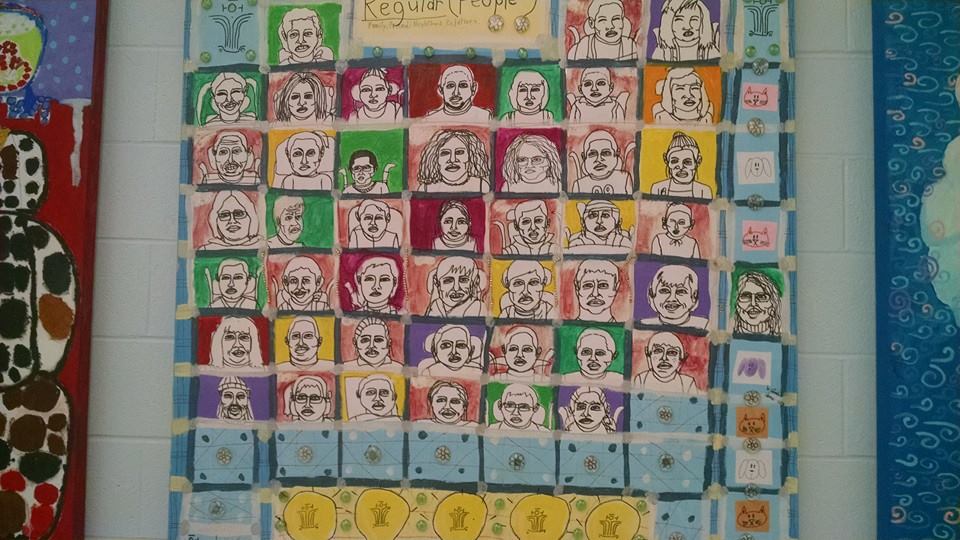
In 2001 or so, right when Bill and I were feeling the first excitement of helping a few really great artists with developmental disabilities get some supplies and attention.  Right when we were in the thick of inspiration, we helped 3 of those artists (Kevin White, Mary Flinker and Antonio Adams) do an installed mural consisting of paintings and assemblages at Bobbie Fairfax School (a school for kids with developmental disabilities) in Cincinnati.  So last Friday I had to go to Bobbie Fairfax School because Star 64, a local TV station, had donated some air-time to my "now" obsession:  employing people with developmental disabilities.  For segments during a movie marathon, Star 64 emcee Storm (I guess it's his real name) interviewed Chase Montgomery, a guy who works full-time in a dining hall at Miami University.  He doesn't communicate verbally that well, but he and his mom and dad programmed his communication device with some great answers to questions about what it means to make a living on his own.  I was there to give Chase a little support:


So anyway after the interview (which Chase totally rocked) I was walking out to my car when I stumbled onto all those paintings and assemblages we did in the Bobbie Fairfax School cafeteria in 2001 with Kevin, Mary and Antonio, and it was just one of those weird feelings that happen when you aren't really ready for it.  I wasn't moved to tears or anything, but I was a little stunned because it brought 2 issues together in a sloppy but somehow meaningful way. 
 
Back then, I was majorly focused on ensuring that Kevin and Mary and Antonio (the list grew to over 100 through the 2000s) had access to cultural/artistic possibilities, with the hope that someday they would be seen as contemporaries of other contemporary working artists.  And even though we were able to establish a non-profit arts organization (Visionaries + Voices) and a small, no-nonsense art gallery (Thunder-Sky, Inc.) on that quest for equality, I'm truly not sure if this ever happened.  It sure was fun and exhausting trying to make it happen though. 
 
And then that idea of doing a lot of work but not getting it all the way right, not reaching that sense of Utopia or true equality, spills over into trying to help people with developmental disabilities access good-paying jobs, which is now my total focus, my new attempt at, for lack of a better word, Utopia.  It takes even more tenacity to do this because it's not just about culture, it's also about economics, a real-world self-sufficiency, and a dialog with HR managers and business owners that isn't about charity or good feeling, as much as trying to make sure the people I'm championing this time can actually do the job, side by side, with some help, but also with the expectation that they can succeed eventually on their own.  I know deep down they can.  It's just finding that right combination of circumstance, personalities, and wills.
 
Chase can.  He's proven that.  And many, many others a lot of people (including me) are supporting to get and keep meaningful work in the community are too.  But it's a never-ending endeavor, full of complications, failures, successes, and so on. 
 
What is "true equality" anyway?  All the way through the 2000s, and even into the 2010s, I guess I thought I knew, but the older I get the more I know I don't and possibly never will.  "Knowing" is a luxury, I've discovered.  "Knowing" anything.  So now I try to figure out things, instead of knowing them.  And I wish I would have "known" this differentiation back in the day when we were figuring out how to do V + V.  Because back then I thought a program could create "true equality."  That sounds really naïve.  Possibly stupid, but all through those years of setting up shows and writing grant proposals and worrying and being stressed and inspired interchangeably, the through-line for me was that narrative of "once we get this up and running, these artists will be taken seriously." 
 
So I put everything I had into establishing a program and all that entails, when maybe I should have been paying attention to what programs actually do and mean.  I'm still figuring that one out.  Because what happened is that by helping to build a thriving program for artists with developmental disabilities I helped establish an institution that needs to be ran and financed, and that means the most important administrative aspect of it all was (and still is) making sure you have enough staff and enough money to pay staff, and in that struggle to sustain it all you kind of lose perspective, even though you gain programmatic accomplishments.  
 
Conversely, now, as I work toward figuring this stuff out, I'm not as invested in creating programs as much as job opportunities, and in that process of course I have to assist people to access employment-support programs that supply job coaches etc., but I don't have to feed those programs anything other than job seekers and possible job leads, incentivizing (one of those wonky words every system likes to use) actual accomplishments specific to a person's life (working and getting paid is central to a majority of people's lives, no matter who you are), as opposed to a program's life.
 
I hope all that makes sense.  Maybe it does, maybe it doesn't, but it keeps reeling through my mind.
 
And so that day as I walked out after the Star 64 interview with Chase and Storm, and I see those paintings and assemblages in the Bobbie Fairfax School cafeteria, it all kind of came together in a crystallized way that made me feel exhausted but also kind of okay.  Look at that stuff we all did, I thought.  Look at those good intentions.  Look at that art, still there, in that empty cafeteria.      
Antonio Adams

Kevin White and Antonio Adams

Kevin White

Mary Flinker and Bill Ross
A castle with flowers flowing out of it.  Talk about Utopia, right?  Everything is about belief, I'm finding out, so you better be conscious of what you believe in no matter what quest you are on.  And the quest I'm on at least right now is trying to figure out how to support people normally shut out of "the world" gain access to it in a way that's not about programmatic concerns.  Using good programs to make authentic relationships and real-world results happen.  What "real-world" means to any specific situation, I guess, is completely organic, but I'm thinking "real-world" in most cases is making a living wage.  Which is a pretty unnerving, lofty and necessary goal for people.

Antonio Adams and Kevin White

Antonio Adams and Kevin White

Antonio Adams
Or maybe it's just about being a "regular person," a trope Antonio Adams uses regularly in his works.  He's a great case in point:  he's still plugging away, making all kinds of great art.  Here's a picture of him today at Thunder-Sky, Inc., in the basement, working on some sculptures for an upcoming show:


He's basically a workaholic, a great example of a "working artist."  And like the majority of his contemporaries, he has a day job at Frisch's.  He's kept that gig, as a busboy, for over 13 years, and when I asked him yesterday why, he said because he likes it and he needs to keep it because of the people there, plus he has to pay his bills.  
 
There you go. 
 

Tuesday, June 1, 2010

"Drawing Always Was His Only Way of Talking"


"Kevin White: Untouched" at PAC Gallery in Walnut Hills is a big and bountiful exhibit, as if the curators were surveying a lifelong career, not just the outpourings of the last year or so. But Kevin is like that. He produces a lifelong career's worth of art weekly, sometimes daily. Curating all that art is complicated because his output can be pigeonholed under "Outsider Art." Kevin has Down syndrome, which may or may not be one of the reasons he is such a genius. I would probably place my money on the idea that it isn't the reason. I think Kevin was born an artist, and the Down syndrome thing was something he's had to deal with to let the art part of himself get recognized. "Untouched" is a great step forward in helping Kevin to break out of this trap.

I met Kevin nine years ago, when he was attending a sheltered workshop for people with developmental disabilities and getting into trouble for drawing when he was supposed to be doing piece-work. Creativity was just leaking out of him in a haze of drawings on paper-towels and napkins and Arby's receipts: odd and delirious configurations of animals and machinery, landscapes and Utopias, monster trucks and angelic onions. His oeuvre was like a portfolio from some unknown European Surrealist from the 1920s, lines murmuring and retracing themselves into dreamy chandeliers made from bones and fur and broken radios. I could go on. What Kevin does is evoke a world by drawing a line. He can do that with a Bic pen or high-quality acrylic paint, on canvas or a thrown-away piece of cardboard.

At the time when I first met Kevin, Bill and I were pulling together the initial stages of Visionaries & Voices, and Kevin was the first artist to attend the day program five days a week. Time well-spent, and it still is, nine years later. "Untouched" is wonderful proof of that. In almost every painting and drawing in the show Kevin is dramatizing some really bizarre and poignant biological struggles. Nature and nurture are often in conflict, and like Alfred Hitchcock Kevin seems to delight in the cruel hilarity. Check out the painting above from "Untouched," not a great photo I know but still... It has a structure and meanness to it, with its cuteness still intact, but waiting in the wings? Black little winged machines ready to read your mind. You get the picture: Kevin is not an innocent. He has some truths to tell, albeit coded and concealed in a visual language we will never quite figure out Thank God. That's just the way the world works: mystery conceals meaning, but meaning still has a voice, like someone yelling from inside a car-trunk. Kevin's sophistication emerges from the way he arranges and manages that meaning and mystery in each work.

The hardest part in curating a Kevin show is delivering Kevin's art to the world while being true to its roots. These works are the musings and experiments of a vital working artist with something contemporary and just plain weird to tell you. Kevin is a genius. I believe that. But I don't think that genius has anything to do with his "disability" or his "outsider" status. Again, "Untouched" provides a catalog of evidence to support this assertion. In fact, if you were to stumble upon this exhibit not knowing Kevin or his biography, you would just simply witness the the work of a prolific artist interested in the high-style clashings of dream and machine, animal and robot, vegetable and virus.

What Gertrude Stein writes in her memoir about Picasso rings true of Kevin: "He was born making drawings, not the drawings of a child but the drawings of a painter. His drawings were not of things seen but of things expressed; in short they were words for him and drawing always was his only way of talking and he talks a great deal."

Thanks to everyone who had anything to do with "Kevin White: Untouched." It's the next step on his journey to becoming what he needs to be.

Saturday, May 1, 2010

What Is to Be Done?


There's this ongoing collaborative project I've been working on for a while, stops and starts. Not a top priority, but it keeps coming back into my head as necessary. The Kallikak Family: A Study in the Heredity of Feeble-Mindedness was a 1912 book by the American psychologist and eugenicist Henry H. Goddard. The work was an extended case study of Goddard's for the inheritance of "feeble-mindedness," a general category referring to a variety of mental disabilities including mental retardation, learning disabilities, and mental illness. Goddard concluded that an entire variety of mental traits were hereditary and that it was important for society to institute a check upon the reproduction of "unfit" individuals.

The book for a time was all the rage in America, and even though Goddard's science was disproven, and he eventually apologized for the book, its echoes and demons still permeate the way we often see people with developmental disabilities. Goddard kind of let a genie out of the bottle, and the eugenics idea that "developmental disabilities" were something wicked and wrong that had to be fixed and/or eradicated still is the way many (most?) people view the issue.

The last chapter of the book is titled WHAT IS TO BE DONE? In it, Goddard states that "morons" and "idiots" and other "mental defectives" need to be colonized and sterilized in order to preserve society.

The book itself is free on Google. I downloaded it and read it and made a couple copies. Above is a photo of Deborah Kallikak (a made-up name) from the book. She is the central focus of the book. The last name "Kallikak" is actually the merging to two greek words, one meaning ugly and one meaning beautiful. The tracing of Deborah's "bad genes" back to a dallience Deborah's great-great-great-grandfather had during the American Revolution with a slutty tavern waitress is the core narrative: Mr. Kallikak had sex with the tavern girl and the progeny were "morons" and "idiots." He married an upstanding landowner's daughter and became a landowner himself, and guess what? The children from this convergence were upstanding, intelligent, capable...

The simplicity seems obviously vulgar now in our politically correct culture, but that narrative haunts perception still... Check out the way people with developmental disabilities are represented on TV and other media, or the way their narratives are constructed for them by the agencies and organizations who "help" them (think "Jerry's kids," or the "We need your help" campaigns for charities and government funds).

The assumptions around class and intelligence and capability and privilege always go unchecked, except by people who no one really listens to.

SO: this idea I have is to "revise" Goddard's tome, update it in a way that is both absurd and sincere, freaky and dead-on serious. One phase was to use the book's pages as stationary for some people with developmental disabilities to write the governor and other policitans in Ohio to request they remove "mental retardation" from the state and local agencies who deliver funding for services. Another phase: a wood panel covered in the letters that make up KALLIKAK was given to Kevin White, an artists labeled with "Down syndrome", who painted over the letters, using the negative and positive spaces made by the print to define his composition. Yet another phase: I gave Xerox copies of some of the exhaustively pseudoscientific graphs and charts that are in the book to a few artists who came to an opening at Thunder-Sky, Inc.; these artists drew over Goddard's science, turning the letters and lines into the beginnings of portraits and caricatures.

Just recently I gave the above picture of Deborah to students in a creative writing class I taught at Miami University as a writing prompt. I asked them to imagine a life and a life-story for the woman pictured. Then after they wrote the piece I told them who she was in actuality (she WAS Goddard's fiction, but real as well), and told them to do some research about her, and the way she received her name, and then to use these "facts" in a revision of the story.

All in all I am developing a portfolio that eventually we'll try to publish at Thunder-Sky, Inc., during an upcoming 2 + 2 = 5 exhibit, set to debut in April,2011. By then I'll have come up with some more "phases" I'm sure. The book will be titled: WHAT IS TO BE DONE: THE KALLIKAK FAMILY REVISITED AND REVISED.

Wednesday, March 3, 2010

Kevin


This is one of my favorite pictures from the opening of "Out of Order: Paintings & Other Creations by David Jarred & Kevin White" Friday February 26, 2010. The show closes April 12, 2010. Kevin took a time-out from drawing that night to explore David Jarred's sculptures... The evening was packed with people, poetry, food, and the debut of Milan DelVecchio's short animated film based on the works. This photo is totally my favorite example of 2 + 2 = 5.

Tuesday, January 12, 2010

Andrew Vansickle on Kevin White


Above: One of Kevin White's pieces in the "Out of Order" exhibit at Thunder-Sky, Inc.

In 1987, Andrew Vansickle spent the summer working under the guidance of Rev. Howard Finster. The relationship and education lasted until Finster’s passing in 2001. He considers Howard Finster his mentor. At the time, when Outsider Art was exploding in interest, Andrew also befriended many of the “Outsider Art legends,” including Mose Tolliver, RA Miller, Billie Lemming, and Rev. BF Perkins. He has helped coordinate a number of art exhibitions in the past 20 years, including one of the first Outsider Art exhibits in Ohio, “Howard Finster: Man of Visions” at the University of Cincinnati Gallery. He is currently the board president of Visionaries & Voices, as well as a working artist, and has known Kevin White for several years. Below are some things he had to say upon seeing Kevin White's work for the "Out of Order" exhibit opening at Thunder-Sky, Inc. February
26, 2010.


When I first saw Kevin's work back in 2003/2004 at Essex Studios in Walnut Hills, I was really taken aback by how much it seemed to have in common with traditional outsider artists like Howard Finster and William Hawkins. I recognized right off that he was going to be one of the greats. He has a raw painterly confidence that totally made me flachback to the late 80s when outsider art began to explode with interest. His work has simplicity, but also sophistication. It's a grand-slam. And I was excited, and still am, at what Kevin's next aesthetic move might be.

Kevin's work can also be easily compared and contrasted with "insider artists" like Franz Klein, Miro, and the constructions of Louise Nevelson. He visually flattens Nevelson's architecture. He does not reference modern art; he kind of uses it without knowing it, which makes for an even more interesting reinvention.

If you ask me what might be Kevin's biggest influence it would his dad. His father was an airport designer and engineer, and Kevin's work truly has a spatial and architectural overlay. You can see that also in the way he lays out all his drawings once he is finished and tries to create a sort of city out of them. Like he is a city-planner conducting business on another planet.

He wants to create a world, in other words. He is truly into organizing and categorizing and at the end of the day his paintings and sculptures have that rare quality of someone totally in charge of their gifts. It's been a pleasure getting to know him, and also collaborating with him when I curated his last exhibit (Summer 2008 at AVS Gallery in Cincinnati). He is a star, and I really look forward to the new show.

Monday, January 11, 2010

David Jarred


Above: 3D Drawamalg 5 . cast paper and acrylic paint. David Jarred, 2009.

In an email interview, Daivd Jarred talks about his own work, as well as the work of the artist he is sharing the spotlight with at Thunder-Sky, Inc.'s "Out of Order," opening February 26, 2010, with a reception 6 to 10 pm.

Your paintings and objects are mysterious and yet also uniquely familiar, like a word you've forgotten how to pronouce but is still in your head somewhere. What inspires you to create them? Other artists' works? Artifacts from the real world? Dreams?

Dave: The focus of my work is the expressive ability of form. When I am making the work I suspend my verbal language and work in a visual language with a vocabulary that I take from other man made forms like buildings and everyday objects such as a clock or a radio. I think people recognize this vocabulary when they see my work, but they are not used to seeing it jumbled up so it catches them off guard. One inspiration for this is classical music, I want to create a visual language that is as abstractly expressive as those used by music composers.

How do you choose the materials you use?
Dave: This is a good question, Since I am interested in form the materials are really secondary to the object. The sculptures could easily be bronze or wood and the paintings could be oil or even etchings. The sculptures are made out of my junk mail which I recycle into paper and press into plaster molds. This process can be labor intensive but I enjoy making paper and it makes me laugh when the unpainted sculptures have interest rates and other classic junk mail phrases on them. Sometimes I regret having to paint over them because the paper is so interesting, but I think it would add unintended content if I did not paint them. The paintings are gouache (acrylic watercolor) and acrylic paint on paper. I think the main reason I have chosen these materials is because I enjoy working with them on a tactile level and I think that it is important to enjoy yourself while you make work. I am also always trying to find ways to reduce my environmental impact so I try to avoid resins, mineral spirits and industrial processes.


You have titled your pieces either a made-up or obscure name (Drawamalgs), and I wonder why, and how do you think this obscure language adds to the experience of viewing and understanding your work? Dave: As silly as it sounds I was writing a statement and I misspelled Drawings as Drawmogs. I looked at the typo for a while and decided it captured something true about the work. I think it plays with the idea of distorting verbal language to become abstractly expressive much as my artwork does with visual language. I later changed it to Drawamalgs (Drawing Amalgamations) so it would make more sense. In Retrospect I kind of wish I had stuck with Drawmogs, but Drawamalgs is easier to explain to people.


What do you think of the work of Kevin White, your partner in the show?
Dave: I feel an affinity towards Kevin’s work, I think it was really a deft move to pair us together. I feel that Kevin really responds to what ever he is painting on in an intuitive way that shows a natural aesthetic sophistication. Kevin is really expressing his own visual language, and in a lot of ways he is much more adept at visual language than I am. It has also been fun working in Thunder-sky inc.’s studio with him. I have begun to see a lot of similarities in the ways that we approach art making. Kevin draws with a cerebral reaction that is very quick and decisive this pretty much how I feel when I draw. I can also appreciate his enjoyment of materials, especially paint.

Anything else?
Dave: Anyone who is really interested in the here and now of art should come check out Thunder-Sky Inc. it is a really interesting place and it will challenge your ideas about art-making and what art is.

Wednesday, January 6, 2010

Unnerving Joy


"Out of Order," the first exhibit in the Thunder-Sky, Inc. not by and/or about Raymond Thunder-Sky, features the works of two artists who, biographically at least, don't have a lot in common.

Kevin White (his work is the top photo)is an artist who spent much of his working artistic life in a sheltered workshop for people with developmental disabilities. Labeled with "Down syndrome," Kevin would draw all the time, with and on anything he could find, and many times he was told not to. But he persisted, and in 2002 Bill Ross, a cofounder of both Visionaries & Voices (a studio for artists with disabilities here in Cincinnati) and Thunder-Sky, Inc., was introduced to him. Kevin, along with Raymond and several other artists, were in fact the inspiration for Visionaries & Voices. Kevin still attends the V&V studio in Northside regularly.

David Jarred is an artist who has a degree in visual art and who writes about visual art regularly. He is just beginning his career, and Bill and I discovered his work late last summer in a gallery in Over-the-Rhine here in Cincinnati, 1305. His work seemed to be both provocatively simple and inherently strange. A lot like Kevin's.

When you put Kevin and David's work together, it completely pops -- as if one of David's objects has been pulled from one of Kevin's large paintings, or as if one of Kevin's paintings is a billboard on David's planet. There is a mutual and eerie happiness in their work, a sort of ethereal and somehow unnerving joy in the oddness and authority both artists share.

The main reason we curated this show is art, not biography, not resumes, and yet knowing upfront that these different people might not have ever met unless they made art really is inspiring. And also it is another example of the 2 + 2 = 5 thesis: pulling together the two bodies of work embellishes both beyond just showing them side by side. Knowing the back story also intensifies the experience of getting to know the art.

By juxtaposing David and Kevin's works, Thunder-Sky, Inc. offers viewers the chance to witness art as an equalizer and the gallery space as a site for new insights into what makes an artist “an artist,” and what makes art “art.”

Show opens February 26, 2010, with a reception 6 to 10 pm.

Sunday, January 3, 2010

The Story of the Pop Cans


In 2007, when we were curating a Visionaries & Voices (V&V) exhibit at the University of Cincinnati Gallery at Sycamore (a now defunct space that was completely beautiful) called "Pop Life: Outsider Artists and the Pop Ideal," Victor Strunk, who was the director at V&V then, came up with an idea: to see if Kevin White, one of the first artists V&V tried to help, would like to paint some pop cans for this show. He did, and he still does. Right after the exhibit came down, Bill got the idea to build some shelving units for the cans, so they could be displayed and sold this way (see photo above). In other words, "Pop Cans" by Kevin White is a wonderful example of 2 + 2 = 5. Someone thought up the idea (Victor), someone executed the idea beautifully (Kevin), and someone else embellished both the idea and the execution (Bill). This one piece, as well, is "co-authored" by Andy Warhol, who originated "Pop Art" and opened up avenues for artists often not cannonized or even exhibited.

(Keith Banner, 2010)